Guy Windsor
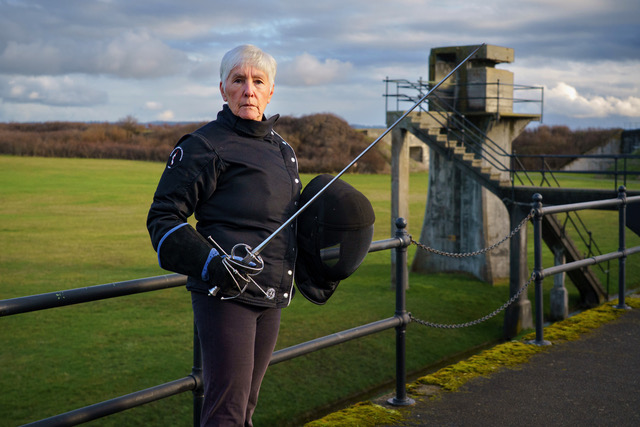
I’m here today with Deborah Fisher, who is a member and instructor with the Whidbey Swordplay Association, a historical martial arts club on Whidbey Island, a ferry ride north of Seattle, Washington. She specializes in rapier and smallsword. Knighted as Dame Virago. We’ll find out just how much of a Virago you really are. She is a former assistant director and instructor for the Seattle Knights, the Pacific Northwest’s premier sword fighting and jousting theatrical troupe, and as Captain Highjack, she is the former leader of a very scurvy and entertaining band of pirates known as the Pirates of Puget Sound. Deborah is a professional writer specializing in instructional materials for teachers, healthcare practitioners and community youth advocates. She has written six books on positive youth development and served as a national trainer for the Minneapolis based Search Institute. She is also a co-author of Stamp of the Century, a nonfiction book about the history of flight and a famous Postage Stamp called the Inverted Jenny. She currently lives on Whidbey Island with her family and a newly acquired mini American Eskimo dog named Mia, who you may hear later on in the interview, because she’s there in the room and she may have opinions, who, at this point, is running the entire show. So without further. ado, Deborah, thanks for coming.
Deborah Fisher
Thank you, Guy, thanks for inviting me.
Guy Windsor
Well, it’s nice to meet because we first interacted when you answered one of my newsletter emails about having rocks in my head. So let that be a lesson to you. If you’re on my newsletter and you feel moved to reply, if I get your email, I will certainly reply to it back.
Deborah Fisher
Guy writes back. That was the first thing I discovered. I thought that was really cool.
Guy Windsor
So you’re on Whidbey Island, correct? Okay, so what took you to Whidbey Island?
Deborah Fisher
Ah, I was raised on the West Coast. I grew up in California. I ended up after college in Minnesota for a number of years because I had friends there. Got tired of the weather and wanted to come back to the West Coast, and my husband and I did some research and decided to settle near Seattle, Washington, but we had good friends that were out here on the island, so when we retired from a lot of the day to day, we decided to move out here. It’s a gorgeous place. We live right in the middle of the island, with a west facing view of the Olympic Peninsula, the Olympic Mountains, and the shipping lane that comes in from the Pacific and goes straight into Seattle. So it is really beautiful out here.
Guy Windsor
Wow. So how far is it from Seattle? Because I’ve been to Vashon, where I have, incidentally, the best Thai food I’ve ever had in my life. An old school friend of mine and her husband live on Vashon.
Deborah Fisher
So Vashon’s beautiful. All the islands are gorgeous. From where we used to live, on the east side of Lake Washington, from Seattle, it would take us about an hour to get to the ferry, and then that’s without a lot of traffic and such, it’s a 20 minute ferry ride from Mukilteo over to the south end of Whidbey Island, so I’d say an hour, hour and a half, north of Seattle.
Guy Windsor
So there may be people who commute to Seattle.
Deborah Fisher
Absolutely. And during covid, it became very, very popular, because we’ve got so many beautiful state parks, and except for a brief period when they actually closed the state parks, this was a great place to come for a day trip, and people could come here and not feel so cooped up during covid because they could be outdoors. So we’ve got beautiful parks all up and down the island.
Guy Windsor
It’s a very beautiful part of the world. Actually, I’d have to say Seattle is probably my favorite American city.
Deborah Fisher
Really? I was bummed to discover that you had been here many times. This was well before I found out about you, and with the way things are right now, not a lot of people are necessarily travelling here from other places, so I’m bummed that I missed you when you were in Seattle.
Guy Windsor
I first taught in Seattle in 2004 at an event, and then from like 2007 or 2008, I was like twice a year until covid, and then after covid, I’ve been back once, I think.
Deborah Fisher
Were you teaching with Lonin in Seattle?
Guy Windsor
Yeah. So I met the Lonin guys sort of early in Lonin’s development. They came to an event in Racine, Wisconsin, and met them there, and they had one or two of my books. And they wanted me to come and teach them stuff and it sort of kicked off from there. So, clearly, our marketing sucks if you’re doing all this swordy stuff in Seattle and you didn’t know that that was going on.
Deborah Fisher
Well, you know, when I retired from the Knights a number of years ago, I just didn’t have sword fighting on my radar. Until a club started here on Whidbey, I did not even know what HEMA was. I didn’t even know it existed. So when I saw an article in the paper that there was somebody had started a club where you can go and swing swords, I got hooked. I got hooked on this, and then discovered that some of what I had done before helped me transition into this, but I’d never heard of HEMA.
Guy Windsor
Well, that’s a perfect segue. So you started out in basically stage combat. So how did you get into that, and what exactly were you doing?
Deborah Fisher
That’s a good story. This is one of my favourite stories. I was 50, my mother had died, and I had a long and difficult year after that, coping with a sense of loss about a number of things, and wasn’t I just wasn’t quite sure what to do with myself, and a good friend of mine said to me, you need to do something dangerous.
Guy Windsor
That’s good advice.
Deborah Fisher
It was good advice, and I took it to heart, but I didn’t know what it was. I didn’t have a picture in my mind of what that might be. I was working on a novel that I wanted to put some sword fighting into it, and I came across an ad for the Seattle knights doing a show at my local library that was in walking distance of my house. So I thought, I’ll go see what that’s about. And they did a demonstration. The Knights used to do library shows, where they would dress up as characters from books and talk a little bit about the summary of the books, and then do some sword fighting demonstrations. And I had never seen anything. I mean, I’ve seen movies, I’ve seen plays, but I had not seen stage combat from a company like that up close, and the thing that piqued my interest is among the five people who were doing the demonstration was a woman. I didn’t know that that was possible, so I started following them and going to their shows, and then check their website for their upcoming season, and there was a note about classes, that classes were starting, and I thought I was being clever. Clever me the writer. I thought, oh, I could take sword fighting and write it off as a business expense. And so I went to class, I called up the director, Damien Willick, and talked with him a little bit, and he very tactfully asked some questions about my background and how old I was. And there was a brief pause when I said I was 50. And he said, well, my practice is anybody who wants to try this out takes their first class for free. See how you like it, see if it’s a good fit. And he told me later he was sceptical, because people my age didn’t usually start at that age. They usually started earlier. But I remember very clearly my first class when he started explaining his fight system, and I was immediately hooked. And the novel has never been finished. It’s still on my to do list.
Guy Windsor
But the novel did its job.
Deborah Fisher
The novel did its job, and I really got hooked. And I was exhilarated and terrified for the first year, it was so out of my experience. But every week, there were two classes a week. We used to meet at the National Guard Armory over in Seattle, and there are four levels of classes that I had to go through before I graduated the school and became a performer for the first summer, for free. All students worked for free the first summer. And every time I had to test, I was terrified out of my mind, because I always thought, Well, I’m going to flunk. That’s what I grew up with in school, as you pass or fail, and that that I learned that that wasn’t the thing. I wasn’t failing. Nobody was going to fail me and say, you have to go back to square one and start over. But I just was exhilarated. And I really loved the work. I love the exercise. I loved how good I felt. I loved how it forced me to think. I love the camaraderie and the acting, you know, over acting, in some cases, like with pirates eventually. So I got hooked.
Guy Windsor
Okay, so the classes are basically to train people to be able to do the shows. Is that correct?
Deborah Fisher
Yes, it’s to learn the fight system that Damien developed, and it’s to learn how to use the weapons that we end up choosing to use, mostly swords. So we start the whole 100 level class is all with sticks. It’s all wooden swords. And if you pass that first test, and somebody put steel in your hands. It’s also to learn how to wear the equipment, because we had chain mail, eventually I’ll acquire armour. So it’s to learn the fight system. It’s to learn how to use the swords and to learn how to work in the equipment.
Guy Windsor
Okay, so you said that there are these tests to get to the next level, but nobody fails. What do you mean by that? Because presumably, some people aren’t ready to pass to the next level.
Deborah Fisher
Yes, I didn’t see that happen. I had one hiccup where my first year, there were only two of us that started, the other person dropped out. My son was having some difficulties in school. I was distracted. I wasn’t able to go to class, so Damien suggested that I start over with a class that was starting right behind me, and that was a class of 10 people, and every person had a TA. He always had a matching number of performers in the knights in the room, so that when everybody was drilling and rehearsing with their weapons, they always had someone to work with, and we all changed who we were working with throughout the evening, so that when we were able to perform, we would have worked with everyone who’s already in our class and already in the company.
Guy Windsor
That makes a lot of sense if you’re preparing people to put on stage fights together.
Deborah Fisher
There was a lot of coaching so that people were prepared for their tests.
Guy Windsor
So basically, it’s not that nobody failed the tests, it’s that no one was put in for the test who wasn’t ready to pass it.
Deborah Fisher
Yes, and it was very basic.
Guy Windsor
I ran a lot of teacher training back when I ran my school in Finland, and I tested quite a lot of people for the class leader exam, which means you’re qualified to run a class on your own. And I never failed anyone, but I tested everyone pretty rigorously because I’m basically trusting them with the safety of the students, the reputation of the school, it’s critically important that those people are properly trained. But the reason we never failed anyone is because we never put anyone up for the exam who wasn’t totally ready for it.
Deborah Fisher
Well said. That’s it exactly. Everyone knew what they were going to be tested on, and you were doing it for 10 to 12 weeks, you were taking it seriously or you were concerned about it, you were working at home, I set up extra sessions with people so I could, you know, it was some drills and basic safety fights. Damien would throw in a few things to crack your composure, because one of the things that we had to learn in performing is, if something happens in the middle of the show on the field, you have to be able to roll with it. So it was testing also of your composure, and can you think in the moment and keep going. So it was performing as well as learning the system and learning the safety and performance of using the weapons.
Guy Windsor
I’m surprised I never came across the Seattle Knights at any point in my many trips to Seattle, because it sounds like exactly the kind of thing that my hosts might have taken me to see at some point.
Deborah Fisher
I wonder if there isn’t a little bit of, you know, one of the things I was thinking about, some people don’t see stage combat as real.
Guy Windsor
I know what you mean. I mean it’s obviously real in the fact that it exists, but I see it as a different discipline with overlapping skill sets.
Deborah Fisher
I agree, I totally agree.
Guy Windsor
Because people ask me all the time, what would you do? I teach people how to fight with swords. Oh, do you do stage fighting? That’s always the next question, almost always. And I’m like, no, that’s a different skill set, because if you do it on stage, everybody should see it, and nobody dies. But if you do historical martial arts correctly, for real, then nobody saw what just happened, and somebody dies. The skill sets overlap, but the goals of the training are fundamentally different. So what is entirely incorrect historical longsword blow where you make it much bigger than it needs to be. You do that in stage combat so everyone can see it, and they know that so and so is attacking so and so. If they do the real thing… I had this problem, actually, with the motion capture thing when we were working on this game in Seattle, like 2012 or something. So I put on the motion capture and I did a bunch of stuff for them, and I came, like, six months later, and I saw some of the video, and I was like, that is not me. I do not move like that. That is fucking ridiculous. And they said, no, that isn’t you. Because when you do it, it doesn’t look like anything. I’m like, it’s not supposed to look like anything. It’s supposed to be I’m standing here, and then suddenly my sword’s in your head, and no one has any idea how it got there. I have trained for years to be able to do it like that, because that’s how you’re supposed to do it. If you actually want to, like, hit somebody with a sword. Yes, but the players won’t understand what’s happened. Well, fine, okay. But yeah, it’s, again, overlapping skill sets, like how to handle a sword and the footwork and all that sort of thing, but the goal is completely different.
Deborah Fisher
Yes, I think you described it very clearly, and one of the things that I thought about when I was preparing for the interview is some other areas of overlap, and one is that Damien’s fight system is based very much in the same historical sources that we are currently using in my HEMA club. So while the movements are bigger, exaggerated or more dramatic for stage, one of the things that Damien was very interested in was using historical sources for the fight system that he built and the work that we were doing. So that was a very pleasing overlap. And I went back and looked at the list of sword masters that were his favourites, that he drew from. It’s some of the same sword masters that we are drawing from as well, like Capoferro, Fiore.
Guy Windsor
I have to show you something. You said the C word. Do you know what this is?
Deborah Fisher
No, what?
Guy Windsor
This is an original Capoferro. This one was actually printed in 1609.
Deborah Fisher
Oh, where did you find that?
Guy Windsor
I got it from a rare books dealer in Italy, and I paid much more than I should have done for it, and I don’t care, because Capoferro lives in my house.
Deborah Fisher
Oh my gosh. Well, here’s my copy sitting right here.
Guy Windsor
Oh yeah, Jared’s translation. Yeah, I have one of those too.
Deborah Fisher
Of course, you do. I can’t imagine how much you have in your library. That is so cool.
Guy Windsor
Yeah, It’s a lovely thing. And honestly, do I need it? No, I have scans. There are plenty of facsimiles and whatever available which have all the same information, but there is a non-zero chance that Capoferro himself once handled that copy. It’s not likely, but it’s not zero,
Deborah Fisher
Exactly. Yeah.
Guy Windsor
So, okay, now in the intro, which you very kindly sent me, and oh, my God, I wish all my guests did the same, I normally have to dig around on the internet for ages trying to find the things they want me to say about them, and then I send them a list, and they say, no, that’s all wrong. That’s not my fault, it is on your website, so knighted as Dane Virago. Now I’m English, and to me, you are knighted when the monarch taps you on the shoulder with a sword. I’m assuming that Queen Elizabeth or King Charles did not tap you on the shoulder with the sword. What do you mean by knighted as Dame Virago?
Deborah Fisher
There are ways of becoming a knight in the Seattle Knights as there are ways of becoming a knight in the Washington Swordplay Association. So for the Seattle knights, the director kept an eye on all the performers. There were the articulated avenues towards knighthood, which is becoming proficient at all the weapon systems that were being used in the company for stage combat. There was a level of choreography that you had to reach to demonstrate your proficiency. And there were things like leadership, which were not strictly articulated, but in terms of your being able to work with everyone in the company, work with the public, produce and direct shows. Or for some people, there was a level of people were promoted to sergeants, so they had a higher level of demonstrated skill. So within the Seattle Knights, it was up to the directors to decide who they felt was proficient and worthy of that leadership within the company.
Guy Windsor
Okay, so similar to the SCA.
Deborah Fisher
Yes, and the Washington Swordplay Association, which we’re just celebrating two years this month.
Guy Windsor
So you mean, is it the Washington Swordplay Association or the Whidbey Swordplay Association?
Deborah Fisher
I’m sorry, Whidbey Swordplay Association. Ryan Voigt, who started the company, has been knighted, and he set up a system for people to become Squires and to spend a year mastering a stated list of skills. And we had our first trials of Knighthood just last weekend, and three more men in the company were granted knightship, and I was granted knightship in this company by virtue of my knightship in the Seattle Knights.
Guy Windsor
Okay, so it’s sort of like within the organisation it indicates a level of sort of skill and integration with the system and authority.
Deborah Fisher
Leadership and being part of a community. I think it’s really important.
Guy Windsor
It’s a lot like our free scholars. In my school, we had a similar thing. To become a free scholar. You had to be doing the fencing at a certain level, but you also had to, I mean, at its absolute root, a free scholar is someone I was perfectly comfortable giving a key to the salle to. You couldn’t just say that, because it couldn’t just be my opinion. I would always confer with the senior students, and it would be sort of like a group decision. But I basically had to feel comfortable handing over a key to the salle so the person could come and go whenever they like. Hence, free scholar and, yeah, so I guess it’s sort of similar.
Deborah Fisher
I think it’s a way to give people something to work towards, you know, to have goals. You know, people have individual goals. But I think it’s, it was good in in both the Knights and the Swordplay Association to articulate goals for people, if they want to try to reach those, they know what they are.
Guy Windsor
Okay, so who is Captain Highjack?
Deborah Fisher
When the first Pirates of the Caribbean movie came out, everyone went nuts for pirates. And so Seattle Knights formed a group of people that were interested in doing those kinds of performances. So we created the Pirates of Puget Sound, and we went through another whole level of training, swash training, to learn how to use different weapons in a different style. And we started booking shows. The company was going to huge pirate festivals down in Florida, there was a big group down there.
Guy Windsor
There are pirate festivals in Florida?
Deborah Fisher
Yes, in fact, there are still pirate festivals in Florida, as far as I know. You know, as the movies came out, the interest waned, and we no longer did as many but boy, there for a few years, we were everywhere, big festivals in Portland, festivals here, out on the peninsula. In addition to doing pirate style characters and fights, someone asked us to create some children’s games. So we created a whole bunch of children’s games that were all pirate themed, and the joke was that we were looking for children who were good at pirate games, who could eventually become pirates. So it was, you know, everything having to do with bat a rat and swab the deck and all kinds of silly things. Parents loved it. We had a lot of fun with a lot of kids over the years being pirates and playing games.
Guy Windsor
So you’re not going to do the rest of the interview in a pirate voice?
Deborah Fisher
I have a funny story for you. We had tall ships come through Tacoma many years ago, and it was for five days. So we did pirate shows and games for five days straight. 1000s and 1000s of people came to see these ships, and we all adopted various accents, French, but mostly British. So we’re all walking around doing our acting, doing our British accents. And I turned and this woman was standing in front of me, and she was a Brit, and she said, why are you all talking like that? And I said, because if we just talk in our normal voices, we don’t sound very interesting. She just shook her head and walked away.
Guy Windsor
It is always kind of funny how accents in English are used to denote various things and like, if there’s an English actor in an American film, they are usually the villain, because all villains need to be posh English people.
Deborah Fisher
So poisonously good.
Guy Windsor
And all pirates need to come from Cornwall. Apparently.
Deborah Fisher
I was put in charge of the pirate unit. I was an assistant director in the company. I was put in charge of the pirates. So that’s that. And to be funny, because the main character and Pirates of the Caribbean was named Jack. We all took names that were variations of Jack. It was called the Jack Pack, so I was captain, Hi Jack.
Guy Windsor
Okay, so then you move to Whidbey Island, and this is this HEMA club opens up on your doorstep. How lucky is that? How different do you find it?
Deborah Fisher
How different do I find it? I did like, even though, even in a highly choreographed show like those done by the Seattle Knights, things could happen that surprise you. I did like the certainty of choreography. We all had standard fights. We were in a big show years ago, and one of the other players, it was hot, he couldn’t do the next fight. He called me in to fight the person he was going to fight. I had no plans to be on the field, but we all knew standard fight one. We knew how to signal to each other who was going to win, who was going to lose. I did the fight. I went back to where I was standing. So I like the certainty of choreography. HEMA doesn’t give me that. I am not afraid of swords. I am not afraid to have a sword pointed at me and get poked and try to poke someone else, but it’s a whole different way of learning. I can use the movement that I know from both dance and stage combat. I know how to use my feet, I know how to turn out. I know how to use my body, but I have no idea, especially if I am sparring with someone brand new, I have no idea what they’re going to do, and I found that a little intimidating at first. I found myself just struggling to defend, and I had no clue how to attack, right?
Guy Windsor
So, yeah, because the one thing we must do in stage combat is hit your partner. Unless you stab them in the face. That is a bad fight.
Deborah Fisher
Exactly, exactly. So it was leaving behind the comfort of choreography and really learning to not be afraid and take risks in a different in a different way.
Guy Windsor
One of the things that prompted me to ask you onto the show is people asked me when I sent out an email to my list recently, and I asked them, like, what would you like me to cover in in my work in the forthcoming year? Quite a few people asked me to deal with the topic of ageing, and I’m quite happy to discuss the topic of ageing from, shall we say, 20 to 50, because I have personally lived that, but I know absolutely nothing about 50 to 70 and beyond. So you started the whole sword thing about the age I am now. I can’t imagine what I would be like if I hadn’t gotten into swords. I think I would probably be a chain smoking alcoholic.
Deborah Fisher
Good thing you got into swords, Guy.
Guy Windsor
Just because I wouldn’t have had any particular interest or incentive in being fit. I’ve never been particularly interested in fitness for its own sake. It’s always fitness so I can do the thing I want to do. And I now I actually quite like the whole sort of physio fitness sort of stuff as well, but that was never what I was really into. So what sort of physical shape were you in when you started the stage fighting stuff in your early 50s?
Deborah Fisher
I was in very good shape. I always had an interest in dancing when I was young, but I didn’t have an opportunity to really start it until I was 19. Okay, there was a ballet class available, and PE at my State College, and I had some scholarship money and some credits left over. And I thought, oh, I guess you can start this when you’re 19. So I did ballet for many years. I did ballroom for many years, and when I landed in the Knights, one of the things I asked Damien, is what do you think makes the difference for being able to do stage combat successfully? And he said, a dance background.
Guy Windsor
Well, for sure.
Deborah Fisher
So that gave me a boost at that age, and I have stayed in very good physical condition, even after retiring from the Knights and I think the ballet, the stage combat. If I had started, because I started two years ago in HEMA, if I had started with no physical background of any kind in particular, it would have been a very different story. But I look at it now, and it seems like a logical extension of the other things that I have done.
Guy Windsor
Absolutely, and that does sort of explain a lot to me. So one thing I’m going to have to do is find someone who started, should we say, in their 50s or 60s, who didn’t have any kind of physical training background.
Deborah Fisher
I did ask, I put a series of questions out to the club, and one of the things I wanted to know, because we have people the youngest members are 13 and 14. I think I’m the oldest member. And every age in between. And I wanted to know what people had done in their backgrounds that they thought helped them, because a lot of them just started HEMA in the last few years, they haven’t done any sword fighting, but there’s a lot of yoga and martial arts, and some people who have dance backgrounds, some people who have sports and weight lifting. So one of the things that I thought was good about discovering that is for people to know that they don’t have to have had sword fighting to start sword fighting. There’s a lot of things that they could have done in their background or are doing that will work for them if and when they do start this.
Guy Windsor
Yeah, so it, I imagine it helps enormously having a physical practice, basically being in good physical shape, reasonably flexible, reasonably strong, reasonably fit, enables you to pick up the new skill without simultaneously having to become fit enough to do it. Because again, I’m coming at this from the perspective of, where should I take this that’s going to be the most useful for people who may be struggling a bit with the effects of ageing, and they want to mitigate those effects to be able to continue training or to take up training. I imagine that you don’t train now the way you did when you were 20. Is that fair?
Deborah Fisher
True. I don’t have the desire for some of the maniac classes I used to take in my 20s, I don’t lift. I mean, I go to the gym and do weight training, but I have no interest and no need to do heavy.
Guy Windsor
So what does your training look like if you don’t mind me asking? In the course of a normal week, what sort of exercise sessions would you do, and what sort of lifts and weights?
Deborah Fisher
I’m glad you’re asking, because I did think about this. For me, the focus of my week is being prepared to do the two hours of swordplay practice on Sundays that we have every Sunday. I want to be prepared and not injured, have enough rest. So it’s all focused on that. So two hours of that. Our county health department here provides a free Tai Chi class every week. I love Tai Chi, and I see a lot of Tai Chi in the Human Maintenance Class that you have, the warmups and the form. So I integrate. There’s a lot of benefit I get that the Tai Chi resets me from two hours of asymmetrical exercise on Sunday.
Guy Windsor
Okay, but Tai Chi itself is very asymmetrical.
Deborah Fisher
The Tai Chi that we are using is both right and left.
Guy Windsor
Interesting. What style is it?
Deborah Fisher
I can’t tell you, I know that the class is specifically designed for, for seniors, for conditioning and balance and strength.
Guy Windsor
Okay, so it’s sort of Tai Chi inspired conditioning. It’s not like traditional Tai Chi, which is designed for hitting people really hard. I mean, the hardest I’ve ever been hit in my life was in a Tai Chi class. When I did Tai Chi back in the 90s at the University Club, we used to train in this old building. So this is room upstairs in this old building. Edinburgh in the 1990s, the building was probably built in about 1800 and we got in trouble with the building manager because we were throwing people, and people were kind of crashing into the wall and breaking the plaster on the walls of this old building, because we were beating it all in a very Tai Chi way. Tai Chi is a martial art. So what you’re describing is not that.
Deborah Fisher
It has its foundations, but it’s a different purpose, and it serves a very useful purpose for me, because it resets me from that asymmetrical two hours. I try to get to the gym twice a week and do weight machines, so legs, lats, shoulders and a lot of stretching. So the tai chi and some of the stretching, some of the warm ups that I do before I swing swords on Sunday. You know, back this way, behind my head, bent over, stretching the hams so a lot of machine work, and a lot of a lot of stretching in between. And walking this dog, getting this dog out twice a day. This is our third dog in this breed, and we call them a very important part of our health program, because they keep us both moving.
Guy Windsor
You know, my granny had terrible health problems, and she died at 78 when really her doctor didn’t understand how she’d been alive the last 10 years of her life, and it was really obvious to everyone else that it was her dog. Because every day, rain or shine, she had to take the dog out, and she did, and yeah, it gave her not only a reason to get up in the morning, which she had plenty of anyway, but just that gentle physical exercise.
Deborah Fisher
Absolutely, good for the brain, good for the body. Yep. So one of the things I thought about is I have a very strict practice and that I like to do the same things over and over again, because, like when I started feeling a twinge in my right shoulder, I want to be able to monitor that twinge. What am I doing to make it better, and what am I doing that might take it from sore to injury and to keep it from going that way? So my routine is very strict, so I can monitor everything very closely throughout the week.
Guy Windsor
I’m the same. The first thing I do when I do any training is like 20 minutes of physio, which is like exercises my physiotherapist has told me to treat or prevent a specific problem, and that segues into going through all the joints, basically looking for trouble. And then when I’ve established that there is nothing that is like clamouring for attention that needs to be addressed now, then I go into sort of fitness stuff and strength stuff and swordy stuff and everything else. But, yeah, I take my time and I go through it all really methodically, because I have made mistakes in that area in the past, and learned to regret it. Like I wanted to do, I think it was 50 push ups on my 50th birthday. And so I started training towards it, which should have been easy, I mean, honestly, that’s not that hard. I hadn’t focused on doing push ups that much for a while, I thought, okay, I’ve got a couple of months. I’ll just get it done. And I got from like 20 to 40 in about 10 days, two weeks, something like that. And I was getting this twinge in my shoulder, and I thought, oh, it’ll be fine. And then a couple of days later, it was really not fine. It was basically a problem that had been there for years, derived from lending my arm to students to practice joint locks on. I mean, I’d done some physio on it here or there, and no one had really been able to fix it. And it was just like, miserable, and so I had to take three months off push ups.
Deborah Fisher
You finally pushed it over the edge.
Guy Windsor
It just got inflamed and annoyed. Well, yeah, then I actually get to my physio fellow person in Finland, Eki, who’s been on the show. As we’re recording this, his episode is going out next week, and yours is going to be a few weeks after that, so you’ll get to hear him. Because he also does Ninjutsu. He’s a Ninjutsu instructor and the best physiotherapist I’ve ever met. And he takes one look at it, fiddles about a bit, and goes, okay, yes, your bicep tendon’s in the wrong place. Here’s an exercise, super simple, stupid little exercise that will just pop it back into place. And here’s another exercise, super simple, stupid little exercise that will keep it in place. And when it pops out, just put it back and it’ll keep popping out for a while, because it’s been out for 15 years. And then, three months later, it was fine, very occasionally, now it might start to twinge a bit, and so I just make sure it’s back in place and it’s fine. And I didn’t do 50 push ups on my 50th birthday, but I did do 52 push ups on my 51st birthday.
Deborah Fisher
Oh, good for you.
Guy Windsor
Yeah. Fuck you shoulder.
Deborah Fisher
It only took three months, instead of a year or to never recover.
Guy Windsor
I was lucky because he said, this is one of those injuries where it doesn’t really do anything, it doesn’t really do anything, and then suddenly your tendon snaps, like you’re just reaching a book off a shelf or something, and the tendon snaps, so now that it’s back in its proper place and everything, it should be completely fine. There’s no reason it would go bad again. But yeah, I was too old to have made that mistake, but make it I did. So let this be a lesson to anyone listening that you know, if it twinges, have a look.
Deborah Fisher
I agree, and I in thinking through this interview, what I looked back on is my career in dance and stage combat, and realized that some of the most valuable lessons I learned were from some of the injuries that I had. In dance, it was preparing for a performance where the director only wanted us to look good and really didn’t care about whether our form was right or not, and it was a very serious injury, and it took me quite a while to recover. I had sciatica, and I was in pain down in my back and under my buttocks, and my director said, well, just sit on a heating pad and it’ll be fine. And it was not. It was not. It took a lot of chiropractic and acupuncture and just time, but that learning that correct form has been very important to me, now that I’ve gotten to HEMA and started if I have a twinge somewhere and I want to reset and make sure that I am doing things properly. Some of the podcasts that I listened to, that you had done, and some of folks in my own club, when I asked them, how do you prevent injury, is giving up sometimes speed. Younger people might be capable, more interested in fast. Even folks in my club that are in their 30s and 40s are already seeing that technique and proper form is really more important than speed.
Guy Windsor
Yeah, and in sword fighting, it’s not your absolute speed that matters, it’s your timing relative to your opponent. So I have lost fights when I was in my 20s and fit and quick to older, more experienced opponents, just because they were moving half the distance I was so they didn’t have to go more than half as fast to be in time. But there is one issue that I think it’s worth just making sort of highlighting, is that historical martial arts were not developed historically as ways of living a long, healthy life. Like Capoferro’s mechanics are designed to keep you alive for the next 90 seconds while you murder your opponent. 90 seconds is a long fight, right? And, sure, okay, some fights went longer. And you see with, you know, for example, Fiore, where it’s medieval knightly combat, the mechanics are much closer to sort of normal walking around than the Rapier stuff, not least because a battle might last for eight hours, not usually that long, but it could, and you’re wandering around in armour all day. So some styles are inherently physically more challenging. And I would say, I mean, I think Capoferro’s rapier is perhaps the most physically challenging style I’ve ever done, and even if you get those mechanics correct, doing them for hours at a time may not be good for your body. Because we tend to say, well, okay, the best way to prevent injury is correct mechanics, which is true, but it’s only the stuff you do for the purposes of keeping your joints in good condition for a long time that will actually have that effect. The stuff you do for the purposes of stabbing somebody who’s far away. It’s great for stabbing people who are far away. And sure enough, it shouldn’t injure you if you do it, if you’re trained up for it, and you do it for a while, and whatever. But it’s not optimised for longevity. It’s optimised for murder.
Deborah Fisher
Yes, and Monday mornings, everything I feel is on my right side, and I spend the rest of the week training, recovering to balance out on the left so I don’t overdo. But you know, if I’m sparring, if I’m teaching and sparring. Everything I feel Monday morning is on my right side. I’m right handed, so that’s the point is this I’m sparring. I’m trying to stab someone. I’m using my right hand.
Guy Windsor
I do all of my sword training stuff on both hands.
Deborah Fisher
I do too, at home.
Guy Windsor
Okay, so you don’t do that in class. Is there a reason why not?
Deborah Fisher
Because I can’t do shit with my left hand.
Guy Windsor
Well, you would, if you practiced.
Deborah Fisher
That’s true. I have a sparring partner who is delightful to do smallsword with because he’s ambidextrous, and he’ll go back and forth and back and forth the whole time, and it was good training for me, as right handed but and I got injured when I was doing the Knights when we got to impact weapons, and I hurt all the muscles right above my right elbow because the weapons were too heavy. I couldn’t use my right arm very well for a few weeks. And the director had everybody working on their left side, which you’re right, it’s a good thing to do is to be able to use our weapons on both sides. So I will keep that in mind for training in the club.
Guy Windsor
Yeah, my senior students are all expected to train everything on both sides. Obviously, you know, if you’re fencing and it matters, then maybe just use a dominant side. And honestly, I can’t fence for shit on my left hand. I can give a technical lesson with a rapier or something with my left hand, but I can’t really fence with it. But I mean, physically, I am fairly symmetrical, because I work pretty hard to stay that way. But like all of my point control stuff, all of my cutting drills, all of that sort of thing. I train them both sides because it’s better for your brain. It’s better for physical development. I mean, I first really tweaked this 2002 maybe when I was learning pistol shooting. And as a kid who grew up with toy guns, I had all sorts of gun habits in my right hand, which were what a kid learns from watching TV. And so I actually got the hang of correct trigger pull on my left hand first, because I didn’t have any habits in that hand. Now, I’m more accurate with my right hand now, but there was a period where I was more accurate with my left because my trigger pull was so much cleaner on my left. When I got the feeling of it on the left side, I could then transfer that feeling over to the right. So for some things, actually it can be useful to learn it on your non dominant side, because you don’t have the habits there. But, you know, sometimes when teaching a class, I will just arbitrarily say, okay, everyone, all the intermediates, so everyone passed a certain technical level, if you were right handed, you’re now left handed. If you were left handed, you’re right handed, carry on, and they have to just carry on doing what they were doing but on the other side. Because also, like, let’s say you’re in a fight and your right arm gets broken, you have a choice. You can just go, oh, well, I’m going to die and die, or you can pick up your sword with your left hand and carry on fighting. Which is the better option?
Deborah Fisher
Well, I’m inspired now. I’m inspired to incorporate that into our practice.
Guy Windsor
The actual sparring is going to be miserable on the left side, but it is kind of fun doing point control stuff. Do you have a point control target at home?
Deborah Fisher
I do in my backyard. I do train on both sides when I’m training at home. And I encourage other people in the club to train at home and to do that as well. Some do.
Guy Windsor
There’s two kinds of students. There’s those that train at home and those that don’t, and it’s blindingly obvious in class, which is which.
Deborah Fisher
When I first started doing it, and I’m doing target practice at home, out in the backyard, and I’m thinking, well, this is no big deal, but boy, that very Sunday, when I went back into sparring, I noticed a difference. So it highly motivates me to keep up with the training at home.
Guy Windsor
So your classes on the Sunday, they sound like they’re mostly sparring. Is that correct?
Deborah Fisher
First hour is lessons. We break out into different weapon systems that people are working on, and then the second hour is sparring.
Guy Windsor
So what weapon systems are you doing?
Deborah Fisher
Longsword. Most of the people are doing Fiore and Meyer. And we usually have new people coming in. Someone new will show up every week. So we’re doing beginning and intermediate longsword. Everyone knew that comes in, no matter what they think they might be interested in we asked them to do the basic longsword lessons first. We have rapier and dagger. We have sword and buckler and we have spear.
Guy Windsor
That’s a big mixture.
Deborah Fisher
Yes, it is. We have a lot of people. There are our clubs all around us, but getting on and off the island is not always expedient, and so I think the fact that Ryan started the club here on the island, there was a lot of pent up demand, and we have a Navy base at the north end. There’s a lot of folks that come down from the Navy base and all in between. So we will have anywhere from 25 to sometimes as many as 35 people on a Sunday.
Guy Windsor
Okay, interesting. So it seems to me like you’re not really encountering much in the way of sort of physical limitations based on age. Is that fair?
Deborah Fisher
Because I’m careful, and I know what my injuries have been, I’m doing fine. I was thinking about the question of limitations of my age. And I think for me, one of the limitations is my brain is not as fast as it used to be. I wish I could learn a little faster. It has taken me a long time, and it’s going to take many more times to be able to, in the moment, read what someone is doing, see an opening and take advantage of it. That is really hard, hard work for me right now,
Guy Windsor
And that’s the one thing that none of your prior training has given you.
Deborah Fisher
No. Because it’s all choreographed.
Guy Windsor
It was all choreographed, whether it was the dancing or the swords, it was all choreographed. So, yeah, basically what you don’t have then is the pattern recognition. This may be apocryphal, but I read somewhere about the, you know, baseball, where you chuck balls at someone with a stick and they whack them. You’re American, you know what baseball is, but something somewhere about some training camp where, like, top level male baseball and female baseball players were training, and just for fun, they had the women pitch at the men and these world class baseball hitters could not hit the women’s pitches. The reason is that men have this very specific way of pitching, and women were pitching in a completely different style, which means that the person hitting watching the pitcher, could not tell from the wind up where the ball was going. They had all of the like hand eye coordination and power and everything else, but because they didn’t have the pattern recognition, they couldn’t anticipate where the ball was going, and so at the speeds that these high class professional women were pitching at, which is significantly slower than what the men are doing, but it’s still pretty bloody quick. Way faster than I’ve ever thrown a ball in my life. These chaps were missing. Now, that may not have ever actually happened. I would have to look up the source and see if it’s actually true. But it rings true because an awful lot of the more advanced, for example, longsword stuff we do is, as you’re coming into measure, how do you modify what you’re doing to give your opponent the impression that you’re about to move this way, and then you move in a different way. And so you surprise them by basically faking out their anticipation system. Because when the weapons actually come together, it’s all happening far too fast for the conscious mind to follow, right? So you’re just at that point, you’re just operating on pattern recognition and instinct, right? So what you have to do, is see what sort of patterns your opponent is expecting, and then give them something different so they can’t react to it in time. So it sounds to me like that doesn’t necessarily have anything to do with age. It may have a lot to do with most people who have your level of experience handling swords have vastly more experience seeing the tempo when it occurs – the pattern recognition stuff, because much more of their previous experience has been that sort of unchoreographed, spontaneous stuff.
Deborah Fisher
Yep, that makes sense.
Guy Windsor
I’m not a neurologist and I’m not a gerontologist. I’m thinking that, you know, pretty much anybody in your situation would probably be struggling with that bit. That’s the only bit you haven’t come across before.
Deborah Fisher
We’ve talked in the club about one of the realities we’ve discussed is it is one thing to spar with each other in the club, because we all get to know how we move. The real learning can take place when somebody comes and I spar with them, and I have never sparred with them before. They move completely differently. Their strength is different, their reach is different, which is why some people like tournaments and find tournaments very challenging, is because they have to go up against someone they have never seen before. And can they stay on top of that.
Guy Windsor
Yeah, I had that experience just over a week ago. I went to Germany to take part in a tournament for the first time since 2003, basically just to see where my skills were at. And I’ve written a great, long blog post about it, which should be up by the time this goes out. So I’ll stick a link in the show notes. So if people want the whole “what did Guy learn when he went to a tournament” thing is there. But, yeah, it’s of the, I don’t know hang on, maybe precise. Of the 16 fencing matches I had in the tournament, I think I’d fenced two of those people before. So that’s 14 new opponents in a situation where there was limited time and they were really trying to win, right? Really valuable, because some of them moved like sport fencers. One very springy young man who was literally younger than my rapier caught me with this. He literally kind of leapt into the air and did a kind of angulated flick shot to my mask. I was like, I saw that in the early 90s on the sport fencing piece. I’ve never seen it done with a side sword before. And I didn’t see it in time. And he was a very springy, quick little sod, and we had a good chat about it afterwards, and it was fine and fun, but he absolutely caught me because I didn’t see the pattern in time.
Deborah Fisher
And wouldn’t you say during a fight, he could only do that once. He wouldn’t surprise you again with that.
Guy Windsor
Oh sure, yeah, because once I’ve seen it once. A really good fencer might hit me with the same thing twice, but it doesn’t happen very often, unless they completely outclassed me in some area, because I’ve spent a lot of time working on it, so I can usually spot the preamble to something when fencing, and so if the same preamble occurs, then I will know what’s coming and I’ll do something about it.
Deborah Fisher
Preamble’s a good word
Guy Windsor
Yeah, even if that’s just a step back, like, oh no, you’ve hit me with this before. I’m not letting you do that.
Deborah Fisher
Someone I spar with dances around a lot, but I can tell when he’s going to make a hit, how his footwork changes, and I know he’s going to come in for something. That’s part of what I love about this sport. It’s what I liked about stage combat, there might be choreography. Everybody’s doing the same standard fight by the same numbers, but everybody moves the same. Their bodies are different, so they would execute a number differently, and you get to know them. And that’s one of the things I do find really exciting about being in this sport and challenging is it’s not just the physicality of it, but it’s my brain. Can I use my brain? What can I learn? How can I get better at this? Which leads me to a question I had for you, if this is a maybe a segue into that and reading some of the podcasts you’ve done where you’ve talked about the idea of peaking at a certain age. I wanted to ask you what you meant by that, because I’ve been thinking about that quite a bit.
Guy Windsor
My primary thing is I’m a martial arts instructor more than I am a competitor or a fencer or anything like that, right? And so as a martial arts instructor, there are various aptitudes that one can develop. Teaching skill is part of it, like the ability to communicate clearly to the students and to create an environment in which they will learn. That’s a skill, and there’s no reason why that should particularly diminish with age. It should just get better and better. But there will come a point where if you don’t have the physical energy to kind of get the class going, it starts to be difficult. I mean, like, some of the best classes I’ve ever taught have been when I’ve been a little bit sick and didn’t really have much in the way of juice, so I couldn’t really get in the way and put on the Guy show. All I could do is basically tell the students what to do, and they’d go on and do it. And actually, it turned out to be a brilliant class, because there is such a thing as too much energy in the teacher. So there’s that, then there’s the ability to perform the art at a high level, which is a combination of technical skill, but also physical aptitudes, like speed, power generation, that kind of thing, and that will tend to peak much earlier than the teaching skills. I actually think I’m physically not much different now to I was when I was 30, right? Because I train differently now, to how I did back then, and I could get the same results with less effort back then, but in terms of like strength and speed and power, I don’t actually feel much different. Maybe, if I looked at a video, oh, my God, I was so much better back then. But I don’t actually feel much different, but it’s generally true that in any kind of physical sport, I mean, the average age of an Olympic athlete is pretty damn low. Some of the rowers make it into their mid 40s, but they are considered geriatric. And none of the fencers are particularly old, not usually. I mean, there’s always going to be outliers, but generally speaking, the average age of an Olympic fencer is pretty damn young, and for good physiological reasons. So there’s that aspect of it, and there’s also just the experience. And up to a point, more experience is better. But I think there comes a point where I mean, okay, the difference between someone who has five years teaching experience and 10 years teaching experience should be quite a lot, but I’ve been doing this for a living for 25 years, I don’t think I’m going to be that much better in five years’ time than I was five years ago. So the improvement rate has dropped off significantly. Basically all the low hanging fruit has been plucked, and we’re into diminishing returns. So all these things sort of come together, so that I think I’m a much better instructor now than I was 10 years ago, and much better 10 years ago than I was 20 years ago, and I expect to be better in 10 years’ time than I am now, but sometime between 60 and 70, I would imagine that physiological processes will make me less proficient in the mechanical skills of the art, and for a while, my increasing experience will counterbalance that. But there will come a point when, I don’t know, maybe, let’s say 90. 90’s a good age. When I’m 90, the responsible thing to do will be to retire. That age may never come, who knows, but it’s not unlikely that there will come a point where, for the good of the students, I should retire, and I should maybe, show up to grading ceremonies, or show up to kind of wave, a sort of, I’ve been in historical martial arts for longer than any of you have been alive. So you know, it reminds me, actually, of a friend of mine, Sean Hayes, when he became a classical fencing master. When he did his classical fencing master’s exam, and he and his cohort were they passed their exam and their master, who, damn, I’m forgetting his name for a second. Oh, my God, he’s a legend. He’s an absolute legend. Gaugler, William Gaugler, he said, Congratulations. You’re all now fencing masters. Now the only difference between you and me is 50 years of experience. There it is, and good for him. I started doing this for a living when I was 27, should we take 27 to shall we say, 90 my quality as a historical martial arts instructor got a lot better, quite quickly in the beginning. It’s still improving I think, now. My skill as a fencer is okay. Now it’s probably still going to be okay in 10 years’ time, if I keep training properly. But somewhere I reckon in when I may be 65 or 70, I’ll have reached the kind of the top of that hopefully very gentle curve, and it will be, however gently downhill from there. But the point of that, is absolutely not to kind of wish a decline on myself. The point of that is, I’m 52 and I’ve been saying since I was 30, I expect to peak at 65. Which means that in all of those years in between, I have not been chasing a short term peak now, which means my risk of injury has been much, much lower. So I will probably be saying when I’m 60, I expect to peak at 75. Because, again, the purpose of a goal that’s that far off is not that you reach it. It’s that it sets you in the right direction, so you’re moving in the right direction. So if I thought of myself as a fencer, I would have expected to peak at 35 maybe, or 30, and I’d now be well over the hill, and I’d have created the conditions of my own decline. But because I can plausibly say, I look at other martial arts instructors and go, oh my God, I had a class with an 80 year old aikido instructor once, and he was bloody amazing. Dude. Okay, right. So I’m going to peak at 80.
Deborah Fisher
It’s context and goals. I really am glad I asked you this question, because I find that very interesting and instructive, because I have tended to think of peaking like an Olympic athlete. If they train right, the timing is right, they hit that day where they do things that shocks the whole world. It’s so incredible, and it might be downhill from there, or they might be able to keep that peak for a few years. So then I just thought about, well, what is the definition of peak for me? And that is, when I’ve been able to achieve things in the forms that I chose, ballet, ballroom dancing, stage combat. Now, HEMA at my age. What can I achieve in these moments in this context, at the age I am at? So it was a different way to think about it, instead of one and done, is how I tended to think of it before.
Guy Windsor
So maybe you should be aiming to peak as a swordswoman at 80. And then when you get to 79 just adjust it up a bit.
Deborah Fisher
Yeah, well, I think of watching videos of some of the famous classical ballet dancers who are in their 80s, in their 90s, and they are coaching young people in their teens and 20s, and they may not have the arabesque or the jumps anymore, but I saw Nureyev late in life, when I was living in St Paul, and he did a show. The only other person he danced with was a younger male dancer. And to see the difference in their bodies was you had to see it to understand it. The younger dancer had everything in the legs, but Nureyev had everything in the upper body, in the arms. The younger dancer couldn’t even come near him, the lifetime experience that he had in his upper body. It was just breathtaking.
Guy Windsor
I think, honestly, to be breathtaking as a performer in old age is a good goal. Yes, okay, so actually, I don’t want to peak at 65 I want to be breathtaking at 65.
Deborah Fisher
You want to be breathtaking. I like that. I was interested when I one of the questions I asked, you know, the survey in my club of, how are you preparing yourself to age in the sport? And a lot of it had to do with I am slowing down and paying attention to what my body is telling me. My sword mates in their 30s are already thinking about whether they’ve had injuries or not, thinking about, really, how do they sustain this? And it’s really slowing down and listening to their bodies, which I’m very gratified to see.
Guy Windsor
And we should perhaps just say, slowing down and listening to your body, doesn’t mean that you’re always moving slowly. It just means that you don’t rush into moving quickly. You might take half an hour to make sure everything is working properly before you do your explosive lunges. It doesn’t mean you don’t do them. It just means you don’t take it for granted that it’ll be there.
Deborah Fisher
Yep, good point.
Guy Windsor
All right, so I guess, I mean, I have a question here. So if you could give any advice to your 40 year old self, what would it be? I think we’ve just given it, which is basically, slow down, listen to your body, don’t rush into things.
Deborah Fisher
I would. I thought about this, and I would go back. I had been invited at the time by professional instructors in St Paul when I was ballroom dancing to compete with them, and I wished I had. That’s an opportunity I wish I’d taken advantage of. I did a lot of ballroom dancing, and it was great. It was fun, but I think I would have enjoyed the competition.
Guy Windsor
Why didn’t you?
Deborah Fisher
Oh, there were people in my life at the time sort of giving me the message that I shouldn’t do that. Unfortunately, I listened to them. It took me a long time to say fuck you to them, but I finally did, and I’m much happier for it, absolutely. So it’s a bit of a regret. But boy, yeah.
Guy Windsor
There’s all sorts of things where, if you choose to, you could regret not doing a thing or doing a thing, but it’s very difficult to predict what will make you happy 10 years from now. It’s also very difficult to remember exactly what the considerations were when you made a decision 10 years ago. And generally speaking, I don’t like to second guess those decisions. Okay, I recently massively reduced my drinking that was a good idea because it was getting a bit silly. And, you know, I’ve written about it on my blog.
Deborah Fisher
And I’ve appreciated reading about it, yes.
Guy Windsor
And I don’t regret any of it, because at the time, in that moment, it seemed like the right decision, and I can’t even say for sure that it wasn’t the right decision. It was just it had some negative health consequences, which I’ve now sorted out and hopefully I will keep things under control from here on. Apparently, I can’t drink like an Italian because I’m not Italian. And it turns out, when you actually look at the medical data, Italians can’t drink like Italians either.
Deborah Fisher
I think one of the wonderful things that sword fighting does for me is it really keeps me in the moment. Whatever else has gone on during the week, I make sure I’ve had a good night’s sleep so that I’m not slow and thick headed. But I really love the practice of physically and mentally being in the moment. We practice outside. We do not have any indoor space, so it doesn’t matter what the weather is here, cold, windy, rainy, hot, and I think the entire club is healthier for it, but it really puts me in that moment. And I think that that helps live a life where one is not regretting and second guessing one’s decision. And I think that’s a very positive thing.
Guy Windsor
Okay, now let me just take a massive left turn here, and ask you, obviously I’ve done the research, I know the answer. This is for the benefit of the listeners. What is the Inverted Jenny?
Deborah Fisher
I was looking at the book this morning to kind of remind myself about the work that we did. The US government in 1918 decided to create air mail, and so the post office created a special stamp to commemorate and kick off air mail, and the Inverted Jenny was a stamp in two colours. So there’s the red or the carmine border, and in the middle of the stamp is a Curtis Jenny, which was the plane that was used to inaugurate air mail. And so a stamp of this kind was a two colour pass. The printer at the post office would print all the red borders, set the sheets aside, and then they would come back and do all the blue planes in the middle.
Guy Windsor
The red border would include, like the details of the stamp itself.
Deborah Fisher
Yes, and I can send you a picture.
Guy Windsor
US postage in a sort of arc at the top and 24 cents across the bottom.
Deborah Fisher
Floating in the middle is the blue plane, which was supposed to be flying right side up. But stamp collectors at the time knew that a two colour pass meant there was a chance for errors, and indeed, a sheet of 100 of these stamps got to the post office in Washington, DC, with the little blue plane flying upside down. And there was a savvy collector at the time, went to the post office, asked for a sheet of 100 stamps, paid $24 and in his hand was 100 of these flying upside down. He asked for any more sheets, and the rest of the sheets were fine, and he very quickly got out of the post office.
Guy Windsor
One guy bought them all, oh my god, they’re like a million dollars each now.
Deborah Fisher
They are well over a million dollars each now. So a friend and I, who were writing together at the time, found out that a friend, a mutual friend of ours here on Whidbey Island, as a collector, had two of these stamps.
Guy Windsor
He had two of them in his house?
Deborah Fisher
Yes, and she asked to see them, they’re legendary. We’d heard about them as kids, and we were three years out from the 100th anniversary of the creation of these stamps and the creation of air mail, which was really the genesis of commercial aviation in this country.
Guy Windsor
And therefore the world. Because, you know, aviation is an American phenomenon, primarily.
Deborah Fisher
We decided that it would be fun to write a book about the creation of this stamp. And the question we came up with, because, how do you write about 100 years of this particular collectible, was where in US history, did the money come from to buy the Inverted Jenny. And so it was all the collectors, over 100 years, how they made their money. What kind of businesses were they in? What kind of collectors were they? I mean, it was wonderful. It was intrigue. And what happened was each of these 100 stamps had their own journey. Some of them hadn’t been seen in 100 years. Some of them were in bad shape. Some were pristine. And we happened to go to an international collecting exhibition in New York City at which one of these was sold, and the granddaughter of the man who bought the original sheet was sitting in the audience. So it was a huge deal. So the Inverted Jenny is that stamp. And we wrote a book. It was hard work, but we had the support of the Smithsonian Institution, the Postal Museum funded some of our research. The American Philatelic Society published and carried the book, and we met all kinds of interesting people all over all over the country and around the world that people who bought this stamp were interested.
Guy Windsor
So, wow. So yeah, I’m not going to ask the address of the guy on Whidbey Island, who has two of them, and has locks on his doors.
Deborah Fisher
Unfortunately, he passed away before we finished the book. We were able to deliver the finished, final chapter that was written just about him to his family when he was in the hospital, and his son read him the chapter out loud before he died. He was wonderful to us. He was very kind to us and helped us understand a lot.
Guy Windsor
So sort of a random encounter made you decide to go and write a book on a stamp. Because your other books have nothing to do with stamps.
Deborah Fisher
Nope. They all have to do with training communities on how to support youth.
Guy Windsor
So do you actually have an interest in aviation?
Deborah Fisher
I do. My husband’s a glider pilot. And I flew gliders for a while, number of years ago, and we moved from Minnesota, I didn’t quite get my license, and then we raised our son. I didn’t we didn’t want to both be flying while we had a small kid, so I didn’t get back into it. But we together have a very mutual interest in aviation.
Guy Windsor
Yeah, I’ve never flown a glider. I’ve done some powered flight, which I just love. I just can’t afford it. I need lots more people to go and buy all of my books and courses so I can afford to get back behund the stick of a plane.
Deborah Fisher
Let’s get Guy in the air.
Guy Windsor
Yes, absolutely. I would love to fly a glider. I mean, one of my favourite things to do in a flying lesson is the practice forced landing, where, basically you pull the engine, so you’re basically gliding, and you have to kind of glide your way all the way down to the ground.
Deborah Fisher
It’s quite the feeling, isn’t it?
Guy Windsor
It is the best. One instructor had me do a practice forced landing where we were basically right above the airfield, about 1000 feet up. He pulled it and he said, okay, the airfield is only half as long as it was. Get us on the ground. I had to bank around, and get ourselves lined up and come in and land right at the back of the thing. He said, after we landed, we’d have ended up in the hedge, but we would have survived.
Deborah Fisher
With the glider, there’s no going around. You come in, you come in, you have to land.
Guy Windsor
Yeah. There’s no going around. There’s no putting the power on and off you go. Alrighty, okay, so I did actually want to ask, you write books on instructional material for teachers, healthcare practitioners and community youth advocates, so you know how to write instructional nonfiction. Okay, what can I do better in my books?
Deborah Fisher
Oh, man, there’s a question I’m not prepared for.
Guy Windsor
I’m sorry, I just thought of it when I was reading out. Why didn’t I notice this before?
Deborah Fisher
Would you do this one? I can’t think of how you would do it better.
Guy Windsor
I didn’t write that book. That was The School of Fencing by Domenico Angelo. Oh, you’ve got my Complete Rapier Workbook.
Deborah Fisher
Which is how I know you, because one of we other people in the club said, oh, we’re going to start rapier, and you know, it’s Capoferro. But here’s this guy who’s done this great workbook that will help us think through it. And so I’m trying to think through smallsword.
Guy Windsor
I love smallsword.
Deborah Fisher
I know you do. I was very excited to hear you say that you love smallsword, but I want and this gets me to another question that you’re going to ask me is I want more of these. But I am sorry I can’t think of how to tell you to do what you’re doing better, because I’d have to think about it. Look at that beauty.
Guy Windsor
Yeah, just for the listeners, I just picked my smallsword that dates to about 1720 off the wall, and I’m waving it at Deborah because, you know, making people jealous is kind of fun.
Deborah Fisher
And she is turning green with envy. That’s beautiful.
Guy Windsor
People underestimate the smallsword. It is absolutely fucking vicious. I’m not sure really what I could the reason I haven’t written a smallsword book is basically because I find the school of fencing. So Domenico Angelo’s book that was translated by his son, while he was still alive. So we can be pretty confident that it’s authoritative. It’s just crystal clear. You can just like, do what’s in the book in the order that it’s stated, and there isn’t really any interpretation to do. Is that not the case?
Deborah Fisher
I don’t find it as easy as you’re describing for me, in terms of reading and looking at the illustrations and trying to comprehend the language. It takes a tremendous amount of work, and I don’t always have the amount of time that I would like to be able to just sit and study. So having a workbook that breaks it down and and videos to go with. It helps me, personally, tremendously, and it’s the way I learn. I thought about, well, how did I learn ballet? How did you know? And there’s, there’s just a multi step process for me, which starts with the reading, the watching, and then the endless practice to get it into my body and my brain, so anything I can have that makes that easier works for me.
Guy Windsor
Okay, here’s where I’ve been going wrong. I started out writing books on historical martial arts to figure out the system and to also do the academic side. So, how to practice this, and what I think the book actually means where that’s not clear. So for example, Fiore needs a lot of interpretation. Because firstly, it’s in Italian so you have to translate it. And then there are a bunch of conventions. There’s all sorts of like he doesn’t give you, generally, really detailed instructions as to how to do everything, whereas Angelo does. But I mean, 10 years ago or more, I started doing books that were not intended to, well, basically, books that were more if you don’t want to read the original, or you can’t read the original, this will tell you my interpretation in a format that is designed for people who are perhaps not, you know, they don’t learn well by reading. They learn better by watching video or by seeing things visually or whatever. Because different people have different sort of aptitudes and ways of going about things. So there is actually, I mean, I can see how a workbook on Angelo’s School of Fencing in the same sort of structure as the Complete Rapier Workbook that you were waving at me where it’s not all of it. It’s just the main bits and the important bits. And it’s organised as classes and organised where all of the drills are written out. But there’s also a video clip so you can watch. I could do that.
Deborah Fisher
I would love it if you would do that.
Guy Windsor
That’s not difficult. Well, I mean, I’ve been doing smallsword for like, 30 years.
Deborah Fisher
I would love the benefit of your experience with smallsword. Along with that, smallsword, I’ve been thinking about this, if all the club is going to do is longsword, I would have figured out how to do that, but I discovered in Knight school, when we got to impact weapons, that there’s such a thing for me as too heavy. Trying to work with a maze stripped out all these muscles right here, above my elbow, and then someone else in the company put a smaller, lighter sword in my hand, which I did not realise was an option, completely changed my career. True. Same thing happened with HEMA. I got into HEMA, and I thought, okay, I guess we’re doing we’re doing long sword. And then someone said, hey, you want to do rapier. How about smallsword? As I completely changed my trajectory in in HEMA.
Guy Windsor
But longsword is less physically demanding the rapier, because a longsword weighs about a kilo and a half, and you hold it in two hands, and a rapier weighs about 1.2 kilos, and you hold it in one hand.
Deborah Fisher
I don’t know, feels different to me.
Guy Windsor
I think, but I’ve worked my fear, sure, but my feeling from what you’ve described, it sounds to me like the mechanics of longsword handling that you’ve been taught are not correct. Because I have trained young, weak people, weak, as in, you know, can’t do a push up, can’t do a pull up. Pull ups are really hard. You know, not physically strong people, but when they’re holding the longsword correctly, it is light in the hands. As long as it’s a nicely made weapon, and it’s properly balanced, and everything it’s, it’s about how it’s being held, because what’s generally going wrong. I have a, I’ve got a blog post on this. I will link to it in the show notes. It’s called, “You’re probably holding your sword wrong, here’s why.”
Deborah Fisher
I’ve read and watched it a million times. Yes, put the link in.
Guy Windsor
If you’re holding a longsword properly, then the muscles of the forearm are doing almost no work. This is a reasonably big, heavy sword. It’s much bigger than the one that you would probably use, but I would wager that you would have no trouble holding this, particularly if you’ve got two hands on it.
Deborah Fisher
And how you’re using the other hand on the pommel.
Guy Windsor
And if you’re holding it correctly, it will just sit in the hand, and you don’t get that kind of tension around here. And also, if the grip is not quite right, then you’re holding it with the strength of the fingers, which is tiring. And then anytime you hit anything, the shock goes into the big joint of the thumb. And so everything tenses up around that to protect that joint, and you get this kind of death grip on the weapon. And that sounds to me like what’s been going on and that well, probably because of how you’re being taught to hold it.
Deborah Fisher
To be fair to my fellow sword mates, it may not be the complete fault of the instruction, but rather my interpretation of what I thought I was being shown. Because one of the things we’ve been talking about in the club is because I’ve really, as I started to feel some things that could turn into injuries, as I’ve watched you spend 30 minutes describing the proper form for a lunge.
Guy Windsor
When did I do that?
Deborah Fisher
Oh, it’s a riff off of the “you’re probably holding your sword wrong”. I’ve been talking a lot to people in my club as they’ve experienced various muscle aches or whatever. I said, Look, proper form is very important, and are we all getting the proper form in our heads? Or is everybody thinking, oh, I’m doing the proper form, but it’s really not. So talking more, and this gets to the question of longevity, and ageing is the consistency of the practice, and whether we as instructors are really teaching people how to use the weapons and our bodies in the proper form. And it isn’t just a movie that’s playing in everybody’s head who think, oh, I’m swinging this sword.
Guy Windsor
To be fair, if I have 35 people and we do one hour of technical practice and one hour of sparring, and there’s three or four different styles going on at the same time. There is simply no way you can be teaching anybody proper form. Okay, like this, the scope for in the class, there isn’t enough time being spent on studying the mechanics.
Deborah Fisher
I occasionally find when I’m trying to teach rapier and smallsword and I always there’s always someone in the class who hasn’t been there in a while, or they’re brand new. Sometimes I pick up a little bit of impatience for spending so much time on the form. Do you find that?
Guy Windsor
No, because I think I’m in it for the teaching. I train with swords, so I have stuff to teach, because my favourite thing is the teaching, not the sword fighting. That is just my nature. That’s not a virtue or anything. That’s just how I’m built. So a student who is interested, quite often at events that I teach a class or whatever, and people will come up to me and ask questions, and I will have intended to fence five different people that afternoon, but instead I spend that time spending half an hour with this person fixing how they’re holding their rapier, half an hour that person fixing how they’re holding their longsword, or whatever, and making significant changes to how these individual students will train that is more satisfying to me than fencing them would have been. I don’t get tired of it. But then again, how we teach physical skills, it shouldn’t be much in the way of like talking about it. So, for example, if I’m teaching somebody how to hold the sword, I’ll say, okay, so you’re holding the sword. All right. So you should be able to stab. Well, the way you’re holding the sword right now, let’s see if you can, if the point is supported, and they understand exactly what I mean, right? Because I put a little bit of pressure on the point, and they go, oh yeah, I can feel that. And maybe you want to cut, okay? So you put a little bit of pressure on the edge. Oh, can you feel that? Okay, so they have a sense of what their current grip is doing in terms of tip stability and edge stability. And then I’ll just make a small change in the hand and say, how does this feel in the tip? And they go, ooh. And then in the edge, and they go, oh, and there’s no explanation required. I don’t have to persuade them of it or explain it. We start with what they’re actually currently doing, and with external physical feedback systems, make these small changes, which make these big differences, and they get it straight away.
Deborah Fisher
We are trying to do that. We do try to be consistent about doing that with all the forms.
Guy Windsor
Any technical correction should be a solution to a problem that the student has experienced. You probably heard me say that before. But you don’t want them to experience the problem of lunging badly and throwing out their knee. You want them to, for example, be able to reach further so you put them a bit too far away, and if their knee is going off to the inside, which will eventually end up with a twisted knee. They can only reach the target if the knee’s in the right place, and so quite quickly, they put the knee in the right place, and they reach the target. And that’s fine, and it’s not framed in terms of you have to memorize these ways of doing things. It’s simply they have the experience of this way of doing it accomplishes their goals, and this other way of doing it doesn’t accomplish their goals, and it just so happens that the way that is accomplishing their goals is correct, because the things that the students are doing wrong is solving a problem for them. They’re doing it because it solves a problem. They’re holding their sword like this, because they have to pick the sword up off the ground and swing it around, and they have to hold the sword. And it’s solving the problem of, how do I pick a sword up and swing it around? But when you adjust what they’re trying to do and make gentle physical adjustments to how they are holding the sword, or just show them quickly how to hold the sword and see how they feel and then when they get that immediate physical tactile feedback, they can feel whether it’s working better for them or less. So it then, of course, under a bit of pressure, it slips. They think they forget about it and that they’re learning some technique or whatever. And so they start holding their sword wrong again, because this is normal. But then all you have to do is just sort of point at their hand, or just tap them on the hand or whatever, and they know exactly what they should be doing, and they make the correction themselves. There’s no need to talk about it.
Deborah Fisher
Which I do when I’m watching, when I’m coaching, two people, two students. Yeah, I find that very effective.
Guy Windsor
Yeah, it’s hard because it requires you to be paying constant attention to all sorts of details, which is difficult. It’s mentally demanding as an instructor, but it’s not particularly difficult if you have a system for studying and teaching mechanics, I think. But again, the right mechanics for sword and buckler are different to rapier. Are different to longsword is different to smallsword.
Deborah Fisher
We’re a young club, and I feel like we are working. We are developing our system for teaching.
Guy Windsor
Yeah, yeah, one would expect. And, you know, it’s not every student wants to spend any time on the details. I mean, like every club does technical training first and then sparring, which, if you think about it, if you’re trying to get better at sparring, that’s the wrong way around. You should do a bit of sparring first. Figure out what isn’t working, do technical training to solve that. Do a bit more sparring. See how that’s going. Technical training to solve whatever problems have come up, and so you drop in and out, but sparring, if you’re trying to get better at sparring, you should start with the sparring.
Deborah Fisher
I think that’s an interesting idea,
Guy Windsor
But only for a few minutes, because it’ll only take a few minutes until you’ve been hit. And as soon as you’ve been hit, you must have made a mistake. And then when you’ve made a mistake, you have something to fix. So then you do whatever drills you need to do to fix the thing that just got you hit. And like, you know, an advanced class back when I used to teach in Helsinki, it would be no do a bit of bish bash, bosh or whatever, and one person might spend the next hour doing solo training stuff to fix something. Someone else might spend three minutes doing a specific pair drill with somebody. Somebody else might spend two minutes doing a specific physiotherapy exercise because they’ve spotted different things they need to train. One person needs to get their hip working. One person needs to work on the specifics of a particular parry. One person has just realised that really what he needs to work on is his point control. So you might as well just do that. And the sparring is there as a kind of measuring device. A diagnostic tool. But again, that kind of targeted training is mentally very demanding. A lot of people who come to a sword class on a Sunday, they want to wander about doing some forms and stuff, just to kind of feel like they know something, and then they want to have some bish bash bosh with their friends, and then go to the pub. And there’s absolutely nothing wrong with that, as long as no one’s getting injured. So, the process I describe, it works for a martial arts class where everyone is focused on improving their skills in a kind of deliberate way. It’s much less good if you’re having a, like a friend of mine runs the Berlin Buckler Bouts in Berlin every year, twice a year, I think. Where they just spar all weekend. And why not? It is not what you do to get systematically better at sparring as quickly as possible. It is what you do if you want to spar a lot of different people and maybe take a bunch of ideas home and maybe make some new friends and have fun. And why the hell not? Because most people are in it for the sword fighting. So again, I’m not trying to suggest that there’s anything even slightly wrong with the way things are currently run, and I’m certainly not casting shade on your instructor. It’s just if you want to targeted training to get better at sparring. You don’t get that with a one hour block of sparring at the end. You get that by doing five minutes of sparring and then fixing stuff, and then five minutes of sparring and fixing stuff, and you’re constantly deliberately working on fixing something specific.
Deborah Fisher
Well, I will definitely bring that back to the club to discuss. They’re going to listen to the podcast Guy, they’re going to hear it one way or another.
Guy Windsor
I am absolutely not trying to tell you guys how to run your club.
Deborah Fisher
But it’s an interesting idea to implement for some that might be interested in doing it that way. We want to expand our range. We’re trying to expand right now to get together more than one day a week, so we can, yeah, specialise in some of our weapons, or we can be at the north end of the island, so not everybody has to commute all the way to the south end or work on different things. So that’s other ideas.
Guy Windsor
Yeah, yeah. Outside is free. So, you could be training like five nights a week.
Deborah Fisher
Yep, yep. Okay.
Guy Windsor
Now there are a couple of questions I want to ask you, okay, because they’re sort of traditional. One is, what’s the best idea you haven’t acted on yet?
Deborah Fisher
You know that novel that I talked about? I would really like to finish that book.
Guy Windsor
Okay, why haven’t you?
Deborah Fisher
Because my mother, unfortunately, a hard working little Italian lady. Her mantra was work first, play later. And unfortunately, what I learned is there’s always work. And, you know, I made my profession as a nonfiction writer and a reporter, but novels, that’s in the fun realm, and so that’s not something that you seriously sit down and do every day, and I’m great on deadlines.
Guy Windsor
Stephen King does.
Deborah Fisher
I know. There’s a lot of writers who are very disciplined in a way that I am professionally, but it’s very easy for me to say there’s many other things, and sitting down and writing a novel is not necessarily my first priority every day.
Guy Windsor
I have a thought for you. There’s something that, like, for example, when I was learning to shoot, a long time ago, I couldn’t really justify the time away from work, but it’s kind of martial arts training, because shooting is a martial skill, right? So when I was feeling like I’d been overworked and I needed a bit of a break, I might go shooting because it’s fun and it’s not sorted, it’s not martial arts, it’s just shooting and it’s fun. When I was feeling like I really want to get some work done, I would go and train some shooting, because that’s work, so the same is true with, like training. You know, when I feel like I really ought to get some work done. Well, I need to stay physically fit to do my job. So training is work. And when I feel like I’ve been doing too much work stuff, I think, well, okay, I’ll take some time off and just do some movement. So just frame it, however it needs to be framed that day for you to do it.
Deborah Fisher
And to not make it this big overwhelming, I have to spend hours and hours at this. I really need to break it down. It’s the same thing with practicing at home. If I approach it from I don’t have an hour to do this, but I do have 10 minutes or 15 minutes to do this. It makes it much more realistic and accessible. So I’m working on that.
Guy Windsor
For all of my projects like online courses or books or woodworking or whatever the hell else I’m doing, what I try to do every work day is push one major project, one concrete step forward. And some days that means I get like, 3000 words of new text down, and it’s pretty clean and fine. Other days it is, I add a sentence and then delete it and then go, ugh.
Deborah Fisher
I fixed a couple things.
Guy Windsor
My favourite example of this is, is one day for, I think it was one of my From Medieval Manuscript to Modern Practice books. It was I emailed my cover designer to say, to ask her to quote for the next one, right? That was something. That was the step. That was all I had in me that day. I sent one email about the book, which basically got a professional who’s going to charge me money to kind of start getting into gear. And you can’t have a book without a cover. So, that email would have to be sent at some point anyway. But now that’s done. And that was all I had in me and I went back to bed.
Deborah Fisher
Yeah. Well learned.
Guy Windsor
So, yeah, and so, if all you have in you is maybe just, like, I don’t know, just read over the last paragraph and go, I don’t like that comma. I think I’m going to get rid of it.
Deborah Fisher
Exactly. And I have had some days where I’ve done that, and on the days that I take the risk and open it up and read it, a fresh idea will come into my head, and that wouldn’t have happened if I hadn’t just opened it up and said, all I’m going to do is look at it.
Guy Windsor
So what’s the book about?
Deborah Fisher
You may find this interesting. It’s a retelling of the King Arthur story. I thought of this years ago. It’s set in Tintagel in the 1980s.
Guy Windsor
Oh, that is different.
Deborah Fisher
And it’s like a Robin and Marion. And it’s interesting, because I thought of this late in life, and now it’s later in life. So having those characters age, be older, and trying to give up regrets for the decisions they made when they were younger. In the context of Tintagel used to have Camelon Fair days for about three days, it would culminate in a big reenactment in battle. So one of the things I learned how to do as a knight is all the components of a festival. So I’ve got these characters interacting in a festival, and they’re themselves, but they’re also these aspects of these archetypes, and how do they work through the regrets that they think they have and then go on with their lives? And I love Tintagel. I’ve been there four times. I love Cornwall. So as I’ve gotten older, the ideas have actually deepened. And it’s like, Deborah, sit down and do this. Because every time I open it, I love this story. I love this story.
Guy Windsor
Write the fucking book. Debra, yeah, thank you, because I would like to read it.
Deborah Fisher
Oh, good. Thank you. That is inspiration, indeed, Guy. Thank you.
Guy Windsor
So when it’s when it’s done and it’s out, you’ll let me know and come back on the show and tell us all about it.
Deborah Fisher
All right. I will do so,
Guy Windsor
Because podcasts sell books, apparently. Okay. Now my last question, somebody gives you a million dollars to spend improving historical martial arts worldwide. How would you spend it?
Deborah Fisher
So this was a very interesting question, and I thought a lot about this, and this is one I put out to the club. And I think the broad answer is, how to make this more accessible for more people. Number of aspects. One is we discussed the kind of workbook approach to some of the texts. Sure people would love that.
Guy Windsor
Are you trying to frame my not having written a workbook on School of Fencing yet as some sort of Guy’s not being sufficiently inclusive? Is that what that is? That’s how I’m taking it.
Deborah Fisher
No, that is not what I’m saying. Because other people in the club said they would like other texts to be more accessible to them as well. It’s not just this one, but it’s, you know, all the ones that they’re trying to work with, and how they may have taken the time to study and figure some of this stuff out. But then, how do we make some of these things more accessible to people that we want to invite into HEMA that may look at this and go, I’m totally overwhelmed. I don’t know how to do this. Standardised instruction for refereeing and judging so that we can all learn how to do that. For a lot of women in the club, it is accessibility through having equipment that fits them.
Guy Windsor
I had a long conversation with Lois Spangler about that on the show.
Deborah Fisher
I think those were the main things. Ah, advertising, just to make this sport more widely known to more people.
Guy Windsor
I’m down with that, because a lot of new people will go buy my books and I can afford to fly planes again.
Deborah Fisher
So accessibility in a number of ways, sharing information, making sure that everybody can get the safety equipment that they want to get that fits them.
Guy Windsor
I think getting equipment made to fit all shapes of fencers will make a big difference.
Deborah Fisher
Yep, Yep, absolutely. I stood on the field yesterday with two women, and we talked about, you know, where can women find protective gear? Can they get it from women’s soccer? Can they get it from women’s hockey? Can they get it from women’s softball? We had a very interesting discussion about it, and I’ve seen it online as well. Where can women find the kind of safety equipment that they need that the choices within the HEMA producers are narrow and don’t fit the full range and it’s true for men too, they don’t fit the full range of bodies of people that want to come into the sport.
Guy Windsor
I mean, particularly bigger people have trouble getting stuff that fits and I get it from a kind of economics perspective, because if you are an equipment manufacturer, having three sizes that fit 80% of people, you can make a living. Having 15 sizes so you can fit the other the remaining 20% of people, it’s a hard road to hoe, so yeah, having some sort of subsidising for that might help, or finding ways to do bespoke stuff cheaper and faster might help, or stuff that’s just simply made to be adjustable. So like a large can be adjusted to overlap with various others, and then an extra large so it’s not like you’re either swimming in it or you’re constricted by it. You can adjust it to fit. Well, if I had the money, I’d give it to you.
Deborah Fisher
So we got to help Guy sell more books so he can fly and he can give money to these sorts of things.
Guy Windsor
That’s an excellent place to finish. Well, thank you so much for joining me today, Deborah, it’s been lovely to meet you.
Deborah Fisher
Thank you, Guy. It’s been delightful. Thank you for the conversation.