Guy Windsor
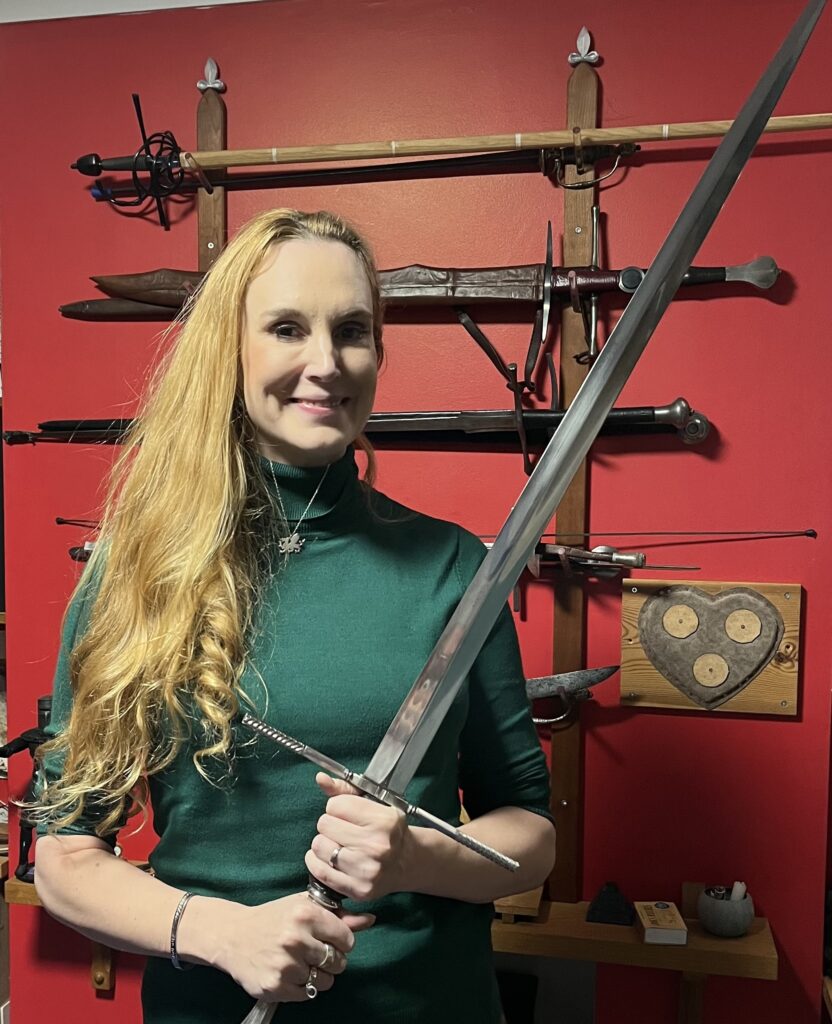
I’m here today with Ariel Anderssen, who is a model, actor, author, property investor, and is perhaps best known for her career as a BDSM model and performer, though her principal claims to fame are actually appearing on episodes 93 and 102 of this very show. I mean, what could possibly top that? And I should remind listeners that she is also mad about swords, which is a fair pretext for coming on the show. So without further ado, Ariel, welcome back.
Ariel Anderssen
Hello. Thank you so much for having me back. How awful to have to work this afternoon talking to my friend Guy about myself. Oh, the pressure. Oh, no.
Guy Windsor
So, just to pile on the pressure a bit with a hard hitting first question, whereabouts in the world are you?
Ariel Anderssen
I’m at home. I am literally at home, but I want you to know that I’ve recently been in Nigeria, which sounds much more interesting than being at home. So please, please let it be known that I do go to places that aren’t my house. But at the moment, I’m in my bedroom.
Guy Windsor
So you’re currently in your bedroom in Wales. Marvellous. But you’ve just been to Nigeria. Why did you go to Nigeria? Other than why not?
Ariel Anderssen
Guy, I went to Nigeria to do a genuine job that related to fighting, which is why I’m bringing it up. Thank God I have something of relevance to say in this podcast, for once. I’m so glad. Years and years and years ago, I used to do a job where I intermittently took part in hijack simulation exercises to train flight crew, but then, for years, these exercises did not happen, and I stopped doing it. And then a flight simulation hijack exercise happened again in Nigeria, and I got to go and be part of it. And it was very fun. I ended up teaching a very lovely ex-military gentleman how to slap me in the face so that he could be a very dramatic hijacker. And it felt like a very strange mixture of my job and my training back at drama school, doing all this sword fighting and armed combat, and my job now as a BDSM model, because it felt like, yeah, a meeting of the worlds, a lovely meeting. It was great.
Guy Windsor
Because you actually like getting slapped around the face.
Ariel Anderssen
I do. I do, yes.
Guy Windsor
In a consensual context, not just like random strangers coming up.
Ariel Anderssen
No, thank you. Please don’t do that if you meet me.
Guy Windsor
I just thought I maybe had better just qualify that. In certain settings, being slapped around the face is fine.
Ariel Anderssen
I do feel I don’t like it if I feel like the person doing it is really uncomfortable with it, and I think he was quite uncomfortable with it, but he asked me, what things can you teach me to do to you that will make me look like a horrible hijacker and, I mean, there’s a limited number of things you can do on a plane. I looked up the things that hijackers have done in the past to people, and some of those are not things you can really do in a simulation. So I taught him how to pull my hair, and I taught him how to slap my face. And I felt like I’d done my professional job. But yeah, it wasn’t the most fun in the world, because I felt quite guilty. I felt quite sorry for him.
Guy Windsor
Do you know it’s something that I often have to get my students comfortable with, is the idea of hitting people. Because, you know, in sword fighting, a lot of the time you’re not actually hitting anybody, but then you get to the point where you’re competing with each other and whatnot, and some people are very, very uncomfortable with just hitting, making physical contact with another person in any kind of way.
Ariel Anderssen
It’s quite taboo.
Guy Windsor
And yet they take up sword fighting lessons and have to confront that taboo, and very occasionally, it’s too much, and they decide they’re just going to do the choreographical stuff and they’re not going to actually try and hit anybody, because that’s just not nice.
Ariel Anderssen
Well, I suppose if you think of sword fighting without much experience, you think of there being physical distance, don’t you? Yeah, like, I remember at drama school, a lot of people were much more comfortable with the sword stuff, where there was distance, than the unarmed combat, where you are closer and you’re, it is more physically intimate. And I think that would extend to me. Sword fighting, you can kind of see it a bit like dancing, but when you’ve got your hands around someone’s throat, or you’re or you’re pulling their hair, or you’re slapping their face. It is very intimate, and there is some discomfort to that. Just like massaging someone you don’t know, feels very uncomfortable, but you can kind of get past it.
Guy Windsor
Yeah, I mean, and if you want to be a professional masseur, you better get past it. Just going back to Nigeria for a second. So you went to Nigeria and so flight crews would come. And just because this is a combat simulation exercise that I know nothing about, but I’m all about combat simulation exercises, so maximum detail please.
Ariel Anderssen
Well, basically, the reason I get hired is because there’s a lot of stuff you wouldn’t want to do to delegates on a course, but you need to kind of ramp up the drama somehow, if you are trying to create a hijack simulation and so to have some performers involved, where you have, of course, already consented to what’s going to happen, so you can kind of make everything a bit more dramatic, without harming anyone or without kind of traumatizing anyone who wasn’t expecting anything to happen to them physically. But actually, it depends very much on where you do these exercises. But sometimes the delegates on the course will really throw themselves into it, and it’s amazing, and it’s not difficult to kind of ramp up the drama.
Guy Windsor
Okay, so, but just the actual exercise itself. So I assume you’re in like a plane fuselage.
Ariel Anderssen
Yes, yes.
Guy Windsor
Okay, so is it an actual plane, or is it just part of a plane?
Ariel Anderssen
This time it was an actual plane. Sometimes it’s just part of a plane. And you do the whole process of checking in, getting on the plane, you get your boarding pass. So it’s all intended to kind of make you feel as much as possible that you really are on an actual plane, going on an actual journey. And then at some point the hijack, the hijacker will start hijacking. And from then on, the idea is you act as though it was real, and you try to survive it, and you try to make sure that people around you survive it. And of course, for flight attendants, that’s really important that they have kind of learned how best to manage someone who’s doing something really strange or dangerous on a plane.
Guy Windsor
Okay, but I imagine, like the training for how do you deal with a rowdy tourist who’s had a bit too much to drink is that the thing you’re supposed to do is a bit different to somebody who’s trying to take over the plane and fly it into a building or somewhere else or whatever else. So you’re all sitting on the plane, and then the hijack starts, and maybe they pick on you as the first person to beat up or intimidate or whatever, to kind of set the scene. What are the staff actually supposed to do?
Ariel Anderssen
I don’t honestly, actually know, because I’m not in the training, so I think what they’re meant to do is comply. That seems to be what they generally do. So they try to help the passengers while trying to de-escalate the hijacker. Because I’m not by any means an expert on hijacking of planes. I’ve read a little about it, but you know, it’s not my day job. But actually, I think the majority of people who try to hijack planes are not what you might imagine, these kind of highly trained ideological people. They’re people with mental illness. So actually, they are not that different, possibly from a drunk passenger who just loses control. They might not have planned to hijack. This might be just something that occurs to them in a delusional state.
Guy Windsor
So they’re on the plane going off wherever they’re going, and then they get hit by a delusion or something which makes them think that they have to take over the plane to save everybody, or the devil is flying the plane and has to be gotten rid of, or something like that.
Ariel Anderssen
So they themselves might be quite vulnerable. And so killing them, for example, might not be the most appropriate thing, I guess.
Guy Windsor
And you know, flight attendants are not trained killers. The skill set is very different.
Ariel Anderssen
I think so. Yeah, I think so. I think they’re all trained in restraint techniques. But, yeah, I’m pretty sure they’re not trained in killing people.
Guy Windsor
It’s like, I mean, long ago when the whole school shootings thing started, there were people suggesting that teachers should be armed, right? And my objection to that was the sort of person who wants to be a primary school teacher or a high school maths teacher or whatever, is not necessarily the sort of person who wants to be trained to draw and shoot a gun at a child. Regardless of what that child is doing. I can totally see that there would be situations in which the optimal outcome would be if the teacher happened to be an armed killer who just shot the child dead before they killed everybody else. Yeah, I’m not saying there are no situations in which that could possibly work, but it’s just, of all the teachers I’ve known, I can think of maybe two who would have, would have been okay in that situation. And actually, having the training yeah to draw and shoot is one thing, but having the training and the capability is another thing. And the kind of people who become military snipers or trauma surgeons are not generally the kind of people who become math teachers or primary school teachers or whatever.
Ariel Anderssen
And yet you could think of two, which is interesting.
Guy Windsor
Well, yeah, but you see, I was a kid in the 80s. We’d had the Korean War and the Falklands War or whatever, and several of my teachers were military veterans who had been in combat and had actually shot people, so they had the temperament to have been volunteers in military service before they became teachers.
Ariel Anderssen
Yes, and if we did change the law, change the rules of becoming a teacher, so that you did have to be able to also fire weapons, I feel like some of the people who might have wanted to be teachers might no longer want to be teachers.
Guy Windsor
I think most of the people who currently want to be teachers would absolutely draw the line at training to shoot children.
Ariel Anderssen
So we might lose these really kind, patient people who’d be really great teachers, and who would they be replaced by? Like, what kind of people would go into teaching?
Guy Windsor
Exactly, and yeah, yeah. And honestly, how many people who are good at teaching are also good at making sure that their firearm is safe at all times? Can be drawn quickly, but not by any of the children?
Ariel Anderssen
Yeah, that sounds like a lot, doesn’t it?
Guy Windsor
Why do prison officers not carry guns? It’s so there aren’t any guns in the prison.
Because if you end up in a situation where a prison officer is overcome by the inmates, because there’s more of them than they are of the officers, then suddenly, those inmates have a plastic shield and a stick, or those inmates have a submachine gun or a semi-automatic pistol or something. Totally different situation.
Ariel Anderssen
So to British people, at least like us, I guess we would agree the idea of having schools that suddenly had as many guns as there were teachers, that makes the school much more dangerous than it was anyway. I’m sure American listeners would potentially feel really differently about that, but at least by our cultural sensibilities, having more guns around does not make things safer at all. And I’m guessing the same on planes, like you don’t want people with guns on planes.
Guy Windsor
Although, I mean on American flights, there are sometimes US Marshals on the flight, and they have, they have a gun.
Ariel Anderssen
Oh, okay, all right. Well, I guess that would make sense with the culture, but certainly, when I was researching for my most recent hijack simulation, I was looking up the sort of things that hijackers do do on planes. And one of the things they do tend to try to do is make holes in the plane, you know, like knock out a window, because, of course, that’s really destructive. I also found out that more than once a hijacker or a disruptive passenger, I guess sometimes the lines are a little blurred, threw faeces at people, but we decided not to do that.
Guy Windsor
Like a monkey.
Ariel Anderssen
Yeah, exactly like a monkey. Yes, exactly. So actually, what we did with our hair pulling and face slapping was very mild, genteel, really.
Guy Windsor
Yeah, I think I’d rather have someone pull my hair. I mean, good luck trying to pull my hair.
Ariel Anderssen
Yes, me too, on balance. But what an interesting thing to look into. It turns out, because I did some research for this job, because I’d not done this for so long. There are four hundred a day on average, episodes where police are called to deal with passengers who’ve done something bad enough for the police to be called.
Guy Windsor
Four hundred?
Ariel Anderssen
Yeah, and that is worldwide, but nevertheless, an awful lot.
Guy Windsor
I’ve been on a lot of planes, and I don’t think I’ve ever seen police called to an incident. I have been on a plane where, once, where, where the pilot says, you know, is there a doctor or a medical professional, right? And I was about maybe eight rows behind where it was going on. A passenger had some sort of seizure or epileptic fit or something, and I saw this, maybe 30 year old woman sitting on the same side of the plane as me, get out of her seat and run across the armrests of the middle row of things to get to the passenger who was having the fit. When that announcement came out, she was like, boom, she was there. And it turned out she was a doctor.
Ariel Anderssen
Well, I’m glad, rather than just delusional, because I have a horrible feeling that if I heard that, my desire to perform would be such that I think I would want to say, I am, I’m a doctor. I’m glad she was a real one, good.
Guy Windsor
If somebody’s having a problem interpreting, you know, medieval swordsmanship on the plane, and they asked for a doctor, I can help. Yes, but yeah, some sort of medical emergency, yeah, they did say, or medical professionals. I thought, okay, definitely not me.
Ariel Anderssen
And did she manage to save the person? Were they okay?
Guy Windsor
I don’t know exactly what was wrong with them, but they were certainly taken off alive. Because when the plane landed, I mean, it turned out that the closest airport was the one we were going to anyway, so we landed as expected, which was helpful, and then we all stayed in our seats, and the medical team came on and took them out in a one of those, it’s not quite a wheelchair and it’s not quite a stretcher, but it’s one of those sort of stretchers they use for getting around tight corners. Yeah, they took them off on one of those and, and away they went. I asked one of the flight attendants what happened. They said they had some sort of seizure. Obviously, they wouldn’t have told me much because of medical confidentiality, but, well, it’s nice to know that they weren’t actually dead, but a friend of mine, who is actually a trained counsellor, thankfully. He was sat going to an event in the states where I was going to the same event, and he told me the story, like the day after it happened. He was sat next to this middle-aged man and his father, and on the plane, on the flight in the middle of the Atlantic, like, hours from any airport, the father had a heart attack and died. And they just covered him with a blanket. And my friend, was just sort of helping to counsel the man who had just lost his father. And then, of course, you know, the plane landed and they took the body off first, with the son, off they went and these things happen.
Ariel Anderssen
I guess those things do happen quite a lot. But yeah, I’ve never seen the police be called. I’ve never been on a flight where someone, but maybe we’re going on the wrong kind of flights. Guy, maybe if we were coming home late on a Sunday from Dublin back to England. Maybe we would see more police being called.
Guy Windsor
Maybe, yeah, maybe if it’s a party flight,
Ariel Anderssen
I think this is very much related to alcohol, I would guess. A lot of these events are alcohol related.
Guy Windsor
I would imagine, yeah, I stopped drinking on planes a long time ago.
Ariel Anderssen
Well, you’re very health conscious, so I’m sure it’s not the right thing to do to drink on planes.
Guy Windsor
No, you get you get drunk quicker for some reason.
Ariel Anderssen
oh, maybe because of altitude, because I know that people get drunk quicker. I was doing a spanking shoot last year in Colorado, and I started to get altitude sickness. I just went a bit dizzy, and at first I thought it was the pain, but I don’t normally get dizzy from it. And I said to the producer, oh, I’m a bit dizzy. He is also a firefighter, and he said, yes, that is because you are up a mountain in Colorado, and people often collapse because of having like, one drink here. And normally they’d be fine, but they are not because they’re at altitude. So that was very interesting, and suddenly he went into kind of first aid mode. And I thought, well, how hot that is.
Guy Windsor
Having a chap who can be very mean to you, but also very nice.
Ariel Anderssen
And then immediately knowledgeable and kind, what a combination.
Guy Windsor
Yes, yeah. I mean, I used to live in Peru, and in ‘86 to ‘92 we were living in Arequipa, which is about 2000 meters above sea level. And yeah, the first few days getting home from school was altitude adjustment. And then if we went even higher, maybe up to Cusco, which is another maybe 2000 meters higher up, something like that. It was really noticeable. But yeah, mate de coca is sovereign for altitude sickness. In Peru this is legal. I don’t know about anywhere else. You take the leaf of the cocaine plant, which is dry, and you make it, make a tea out of it. And you can, literally, buy the tea bags in the supermarket.
Ariel Anderssen
How old were you at this point?
Guy Windsor
A teenager.
Ariel Anderssen
Okay, okay, so, so you’re on cocaine.
Guy Windsor
Well. But you’d need, like, four kilos of the tea bag to make one snort of cocaine. I mean, like, the refined cocaine is the active ingredient in the coca leaf, but it’s like, you wouldn’t just take, like, spoonfuls of pure caffeine.
Ariel Anderssen
So you were micro dosing.
Guy Windsor
No, I was having like mate de coca, which is a perfectly normal drink in Peru.
Ariel Anderssen
Okay, all right, yeah.
Guy Windsor
Well, your mouth goes a bit numb, because cocaine is an anaesthetic, yeah, but it just takes away all of the sick, dizzy feeling of altitude sickness. Oh, I did not know that. And it doesn’t get you high in any meaningful way. I mean, you couldn’t just drink 10 cups of it and Okay, it’d be like snorting charlie. Like, no, okay. It doesn’t work like that at all.
Ariel Anderssen
And then when you came home again, if you came back to the UK, were you super fit for a while because you’d basically done altitude training?
Guy Windsor
Well, not really, because the jet lag and you always feel wretched after intercontinental flying anyway, so, and it wasn’t like I was an athlete, particularly. So it wasn’t like I had a way to measure it. One would assume that there would be a period where I was fitter than usual, but I don’t know.
Ariel Anderssen
You don’t have a record of that, that’s a shame. Go and do it again and report back, please. Thank you.
Guy Windsor
Well, I would love to go back to Peru. Actually, I haven’t been back since 1992. It’s very expensive to get to. I’d like to take the children.
Ariel Anderssen
Yeah. Cut it out if you’re not allowed to talk about it. Are you still going to maybe go to Japan?
Guy Windsor
We haven’t discussed it on the show. So no one knows what I’m talking about. So a bit of context. What, Ariel is talking about is there’s this scholarship thing you can do, where you go and spend a year learning Japanese and get a job in Japan for that year. And it’s basically a cultural exchange thing, and that it’s sort of funded in various ways, and I thought it would be a super cool, interesting thing to do, maybe once my youngest has left home and it’s on the yes/maybe list, it sort of depends on, see, I don’t want to commit to it before the youngest’s university prospects are settled because we don’t know what grade she’s going to get. We don’t know which university she’s going to get into, where she’s going to go, how she’s going to feel about that. It’s like we may need to be around, sort of holding hands and stuff, of course. Yes, a bit yeah, after she’s settled, hopefully on a medical degree, which is going to take years, then when she settled in, and eldest is if, assuming eldest is fine or whatever, then apply for it.
Ariel Anderssen
Yes, very exciting. And it sticks in my mind, just because I find it horrifying. As I know I said to you before, when you first mentioned it, it just seems so brave and the way you live your life, I do find quite inspiring, because I think you don’t seem frightened of change at all, which interests me a lot.
Guy Windsor
Okay, well, it’s very flattering. I’m not sure it’s true.
Ariel Anderssen
I mean, when I compare it to maybe myself or to some other people. I know it just feels like, you know, like you’ve had multiple careers, you fully committed to one career, and then you retrained for a whole different career. And I wouldn’t be surprised if you did that again. And that is not something that I like the idea of, I like the idea of adding careers to my career, but I don’t want to have to fully commit to doing something completely different. That sounds awful.
Guy Windsor
Okay, yeah, I am generally okay with change.
Ariel Anderssen
Yeah, exactly. That’s what I’m saying. And so the idea to you of going to a country where you don’t speak the language yet and you are not culturally plugged into how it works yet, and you will go there and learn a whole load of new stuff while you’re there. And you feel, on some level, like you are equal to that challenge. That interests me.
Guy Windsor
I did it many times as a kid, when I was five, we moved to Argentina. I didn’t speak any Spanish, and that went fine. We were sad to leave less than two years later, because my dad’s job thing changed, yeah. And then we moved to Botswana where the language wasn’t an issue, because everyone spoke English. It’s the national language or one of the national languages, but the culture was quite different. And then we moved to Peru. I didn’t speak Spanish, but I learned it, and it wasn’t that hard, because Spanish is a relatively easy language to learn if you speak English.
Ariel Anderssen
And Spanish speaking people generally seem quite kind if you haven’t got the perfect accent, compared to some other countries. So yeah, I agree.
Guy Windsor
If in Peru, if you are English, and you’re speaking to them in Spanish, they are massively kind about your Spanish, yeah.
Ariel Anderssen
And that does make a difference to your confidence in trying it.
Guy Windsor
And then Finland, I guess, would be the next one, and that went great. Loved Finland. So it’s not the notion of going to a country where I don’t speak the language. It’s not like I’ve never done this before. This is big and scary. This is just a variation on something I’ve done several times before. And every time I’ve done it before, it’s gone great. I have fond memories of all these places.
Ariel Anderssen
Oh, that’s lovely. Still. Still, it impresses me, because at the very least, it means that you are leaving behind for a while a whole lot of comfortable things, like people you know and shops that you understand how they work, and walks that you know about, all of that just comfortable, familiar stuff. And I would certainly find that frightening myself.
Guy Windsor
But like when I go to a new place, let’s say we go on holiday somewhere, I tend to get into a routine really quickly, and I want to keep some aspect of every day the same as it was the day before, so there’s not too much new stuff in a given day. Obviously, on the first day, everything is new and overwhelming. But like, I mean, the example that pops into my head for no reason was 20 years ago I visited ago I visited Prague to visit some armourers, to get them to make cornets and stuff for me and also and have a look at Prague. And it was basically an excuse to go to Prague. Why not? And I was on my own, and there was this sushi restaurant very near the cheap little hotel I was staying in, and I had lunch there every day that I was in Prague.
Ariel Anderssen
Okay, yes, right. Yes, I relate to that for sure.
Guy Windsor
And Prague is not famous for its sushi. I had dinner in different sort of Czech style restaurants, different one each night, but I just kept breakfast was in the hotel. Lunch was in the same place each time, because that just kept the variations down a bit.
Ariel Anderssen
And it gives you some kind of safety and predictability, which I certainly relate to. I like that.
Guy Windsor
okay, but honestly, I don’t think of your career as particularly safety, predictable minded.
Ariel Anderssen
That is possibly fair from the outside. I mean, from the inside, I know that what I do actually is I work with a very small number of people repeatedly. So it’s kind of like an extended family of people. And yes, I go all the way around the world to do it, but perhaps a little bit like with your job, you might go around the world, but, but you’re meeting people with whom you have something compelling in common, which certainly helps, and that makes everything feel quite a lot safer, because it’s not like I’m suddenly meeting Quantity Surveyors, or, I don’t know, I can’t think of another job that’s completely unrelated to my job. I’m meeting people with whom I’ve got a lot in common, and that certainly makes it feel quite a lot safer.
Guy Windsor
Yeah, visiting a new city to go to a sword event, it’s totally different when you’re being picked up from the airport or whatever, by people who you may not have met in person, but you’ve corresponded with, and they take you to where you’re going and whatever, and you’re immediately part of a network. You’re not just on your own in this big, strange place.
Ariel Anderssen
Yes, yes. So actually, although I think the first couple of years of my career required me to be quite brave really, I had to be quite comfortable with risk. That has become less so as I got older.
Guy Windsor
And that’s the thing I was really thinking of, because you came from a ‘sheltered’ is the wrong word, but in many respects, sort of sheltered background. And then you after drama school, and then you go pretty much straight into the porn industry, which is like as far as you could possibly get away from home life.
Ariel Anderssen
Yes, yes. That is true.
Guy Windsor
So that must have taken quite a lot of bravery, because I presume your parents didn’t approve.
Ariel Anderssen
No, not really. You’re right. I think, though, what do I think? I think that our sex drives are very powerful, so that really helped. It’s not like I had to think, oh, can, can I be brave enough to go to Los Angeles and do BDSM? It was more that, once I found out that BDSM was in Los Angeles, my impulse to go there and experience these things was very strong.
Guy Windsor
Stronger than the fear of what might happen if you did it?
Ariel Anderssen
Absolutely, yes, absolutely. And also, you only have to be brave enough for one day at a time, don’t you? So it’s not like I had to commit to 20 years’ worth of BDSM shoots. I had to commit to one week of BDSM shoots to begin with.
Guy Windsor
Sure, but there’s a there’s a threshold right where, once your face is there in a porn movie or set of naughty pictures or whatever you call it, once that’s out there, there’s no putting it back.
Ariel Anderssen
No, that’s true.
Guy Windsor
And so I can imagine, like the first one would be the hardest for that reason, because there’s no coming back from it.
Ariel Anderssen
I suppose you’re right, and I’m sure it would feel like that to a lot of people, but honestly, at least in the early 2000s which is when I graduated from drama school, so many of the roles for young women at that time were so sexualized, and honestly, looking back, quite exploitative. I worked for four years as a mainstream actress before I started doing porn, and I’d been a dead body multiple times, victim of sexual violence, or murder multiple times I’d been naked and I played sex workers, all of these things, and all of these things are seen as completely acceptable and appropriate. And so all I was doing was I was doing it in a different context. So, you know, I’d already played a lap dancer in a mainstream movie. And basically, if you’re playing a lap dancer, you are being a lap dancer. It’s just that you’re kind of given permission and you’re not stigmatised. So really, it felt more honest to me to just do the things I actually wanted to do, rather than looking for mainstream roles where I’d get to do them and say, oh, but I’m not really doing them. I’m an actress. And so it felt more comfortable to me to be actually honest, rather than play at these things.
Guy Windsor
There is a ferocious double standard.
Ariel Anderssen
Yes, there is.
Guy Windsor
There is so much stuff, it’s absolutely okay to put it in the movie, if it’s not supposed to be a movie people are wanking off to, although you have no control over what people do when they’re watching your film. But if you put it in porn, it becomes somehow, I mean, I remember, 5, 10, years ago, the government tried to ban choking, for example.
Ariel Anderssen
Oh, yes, they’ve just done it again, actually, it’s just gone through.
Guy Windsor
Yeah, and I totally get that you don’t want to be suggesting to people that it’s somehow safe to choke. It’s a very dangerous thing to do. And, you know, I’ve trained the martial arts side of choking, so I know how.
Ariel Anderssen
Have you?
Guy Windsor
Of course, yeah. I mean, it’s a way of killing people.
Ariel Anderssen
That’s true. I just didn’t really think of people armed with swords as resorting to choking. That’s interesting.
Guy Windsor
Sometimes you know you’re too close to use a sword or, and the reason, one reason you have to, like, train the choking side of things, is because you have to train what to do if your opponent is choking you. And you can’t practice that without practicing how to apply the choke without actually killing your training partner.
Ariel Anderssen
So what do you do if someone’s trying to choke you, Guy?
Guy Windsor
It depends on how they’re doing it. I mean, the probably the best choke is when you wrap your arm around the person’s neck. And you’re basically choking them out between the inner bone of your forearm and the bicep. And you kind of crank it on. And that, that’s basically a carotid choke. And you can get them to pass out in maybe 10 seconds or so.
Ariel Anderssen
I’ve thought the thing to do would be to turn into it so you’re facing them. But I don’t know if that’s actually that’s actually possible.
Guy Windsor
But then, then you know to complete it, you the hand is around the throat, that hand goes into the elbow, and the other hand goes to the back of the head. And then you have a neck break if you want it. Do not practice this at home without professional supervision. I’m not talking to you, Ariel. I know you’re sensible, but listeners don’t do this. This is extremely dangerous. It requires professional supervision or somebody will get killed. I have a friend whose neck was broken this way. Don’t fucking do it. But once, once that choke is on, if they apply it super hard and fast and break the neck, it’s done. If they’re choking, you have a few seconds in which to basically get blood going back into your brain. And there are ways to, for instance, break a couple of fingers, and once you have broken the fingers, they’ll probably let you move their arm. That’s one way of doing it, okay. Another is if you can get an elbow strike into the correct rib, that might loosen things in, then you can then do something else. I mean, there are various ways.
Ariel Anderssen
So they’re kind of indirect. You do something else that distracts them.
Guy Windsor
Okay, if you can get a thumb back into an eye or something, that’ll help. But again, you don’t have much time. If they’re choking you by compressing the airway so you can’t breathe, you have more time because there is some oxygen in the blood. Oh, and the blood is still getting to the brain and back. The thing that makes you pass out is loss of oxygen to the brain. Insufficient oxygen to the brain is what causes the unconsciousness. So, depending on how you’re restricting it, you have more or less time. And so if you’re restricting the airway, again, super dangerous, absolutely don’t practice this, you know all of that, but you have a bit more time. Usually it’s something like, they’ve got their hands around your throat, for example, you will want to break some fingers. And the thing is, the hard part for most people is the socialisation aspect. Well, even when somebody is putting you in a situation where you could die it is difficult to get somebody’s head around the idea of making a spear out of your thumb and ramming it into their eyeballs hard as you possibly can.
Ariel Anderssen
Okay, I would have thought your instinct you want to live would override any socialisation. But that’s really interesting.
Guy Windsor
No, but also because you’re maybe afraid of making them more angry, right? Because maybe they’ll let go, but if you stab them in the eye, maybe they’ll actually kill you. Now, maybe they’ll kill you anyway. But again, it’s not a fully rational working out of the probabilities.
Ariel Anderssen
You see, this is really interesting. Because actually, in my book, as you’ll know now, because you’ve read it, my new book, I’m talking about a sexual assault that I experienced and I did not handle it well. I know I didn’t, because the possibility of it escalating if I resisted, was too frightening to consider. And I guess it’s just the same thing, but very but played out very fast. You know, someone’s really hurting you, and they might be about to kill you, but you might make them kill you faster or more if you do the wrong thing.
Guy Windsor
Again, we’ve strayed quite far out of my area of expertise, let’s be quite clear, I am not an expert on actual assault of any kind, and the psychology of that kind of assault at all, right. I’ve read a bit and studied a bit and practiced a bit, but it’s not my, my area of expertise. So if people listening who are actual psychologists of combat or whatever, want to chime in and say, Guy, you’re fucking wrong. I am prepared to listen. But this is, this is just sort of my opinion, based on the reading of stuff, and of course, training in Jiu Jitsu or Kung Fu, whatever else. Or Armizare, you know, we have chokes and submission holds and all that sort of thing. And it’s quite a scary thing like, the most recent thing where this, this sort of thing kind of almost occurred, in a much, much less severe context. In a fencing tournament I was in recently, my opponent did something that I believed was against the rules. The only thing I knew to do about it, because basically what he did was he dropped his sword and he tried to do a takedown on me. And I thought that that was against the rules. It turned out that by a certain reading of the rules, it was actually kind of allowed.
Ariel Anderssen
I’m very surprised.
Guy Windsor
But in the moment, I thought it was against the rules, and the only thing I know to do about it is definitely against the rules, because it would involve putting on an arm lock, because the way he came in. I could have gone down for the hips and maybe done a hip throw, or I could have gone for the arm that was coming up to my head and maybe broken the elbow, or at least, damaged it. But I didn’t have a tournament rule specific yes solution to this problem, and so I was stuck.
Ariel Anderssen
What did you do?
Guy Windsor
I just sort of kind of stood there and moved back a bit and whatever. And it kind of looked like he was pushing me out of the ring, whatever. And nothing bad happened.
Ariel Anderssen
But how interesting, that kind of, not having permission in your mind.
Guy Windsor
It put me into that state where even though I knew what to do, I couldn’t do it because I thought it was against the rules. And the rules matter in a way that you know, when you attend somebody’s tournament, you agree to follow the rules, and so that kind of matters. And that’s a very low stakes thing, and when the stakes are much higher, the rules become more important, not less. So when I can totally see why, if somebody’s being choked out and actually murdered, they might be trying to placate the person the whole way down, instead of sticking a thumb in the eye or breaking a finger, doing the thing that they think will actually get them out of it, but will risk escalation.
Ariel Anderssen
It’s very interesting, this strangulation and choking thing. So the law changed in the UK specifically, last year, I think, autumn last year, so representations of strangulation or choking are no longer legal in porn, specifically, so still totally, totally fine in mainstream media.
Guy Windsor
So you can have it in TV?
Ariel Anderssen
Oh, yeah.
Guy Windsor
But you can’t have it in porn. Why?
Ariel Anderssen
Because they accept that in mainstream movies, people are acting, and in porn for some reason, a government doesn’t accept that we might just be acting, which is very odd.
Guy Windsor
I’ve read your memoir, both of them in fact, and I am pretty sure that an awful lot of your job is acting.
Ariel Anderssen
Yes, yeah. I mean, I’m sometimes pretending to eat sentient fruit that’s talking to me. This is definitely acting.
Guy Windsor
And at one point you did pretend to be eaten by an alien.
Ariel Anderssen
Yes, yeah, 100% also that. I mean, I was a vampire headmistress stepmother. I mean, I do a lot of acting. It’s absolutely true, and it’s very strange.
Guy Windsor
Are you honestly telling me you are not a vampire stepmother? Or a headmistress?
Ariel Anderssen
I am not. I am not.
Guy Windsor
How dare you represent one on TV?
Ariel Anderssen
I’m just very culturally insensitive. But the thing that I’m finding very interesting about this new ban, because the law treating porn differently from mainstream drama is no new thing. But the thing that’s interesting is, because it’s new, I’m waiting to see what our government decides is strangulation and choking. Because, for example, a posture collar, which is like a high collar that you’d be wearing around your neck. I mean, theoretically you could use it to strangle someone if you put it on really, really tightly. But obviously it’s also perfectly safe to wear one in a normal way.
Guy Windsor
Presumably you could wear one for hours at a time.
Ariel Anderssen
Absolutely. Wearing a hood over your face could theoretically suffocate you if there are no holes in it, but you can’t necessarily see if the fabric of the hood is easy to breathe through or not. So I think what we’re likely to see is it being applied in situations where no one was being strangled or choked at all. And so I’m sort of waiting to see how that plays out, because it might be that by the new standards, a whole load of the stuff I shoot could be considered strangulation and choking, even though, clearly, I’m not actually doing any strangulation or choking at all. So I’ll be interested to see what happens with that.
Guy Windsor
Yeah, it’s just freaking weird.
Ariel Anderssen
It is pretty weird.
Guy Windsor
It seems to me one of those things where there’s a sort of paternalistic view that that people are being exploited and so must be protected, and so they go after people like you, who are, if you don’t mind me quoting your actual book, millionaire porn producers as somehow exploited versus like underpaid under educated people from disadvantaged backgrounds who are working shitty jobs for multiple hours of making no fucking money and being actually exploited by actually powerful rich people.
Ariel Anderssen
Yes, it’s a very, very odd thing. At the moment because we’ve got a kind of current hysteria about sex trafficking. And clearly, I mean sex trafficking is an absolutely horrific thing to happen, for sure, but I’m finding it increasingly difficult when I’m interviewed by people who outside my industry who don’t know me already, to kind of prove that I’m not being trafficked. And I think not only am I not being trafficked, in 23 years in the porn industry, I’ve never even met someone who I thought it could be plausible that they were being trafficked. The most I’ve met is two women, again, in 23 years, where I thought they had a boyfriend who was a bit more pushy about their career than I thought was very healthy, but that’s right, twice, and that’s very minor, compared to actual sex trafficking. Whereas I feel like we probably have in this country a lot of people who are trafficked into picking our fruit and vegetables, and it feels like we’re ignoring a massive problem and sort of inventing the problem that people like me are actually exploited victims, when I’m in my own bedroom in the house that I bought shooting the content I’ve chosen to shoot, and it’s difficult when people persist in trying to push this kind of victim card onto you.
Guy Windsor
I mean, obviously, there are victims in any industry, pretty much, and not all porn performers are in your position. But I don’t know, I haven’t really looked into it, but I would imagine that more sex trafficking goes on in producing girls for people like Prince Andrew than girls for porn producers.
Ariel Anderssen
Well, it does seem like if you wanted to sex traffic, which clearly neither of us do want to do. I mean, it would be pretty fucking stupid to make video evidence of it and then publish it.
Guy Windsor
Exactly, that’s it. It’s a crime. Why would you produce evidence that could be produced in court?
Ariel Anderssen
Yeah, and most particularly, I think, if you were trying to traffic a woman, me, for example, making videos of her appearing to be in distress, like as a submissive in a BDSM production, would again, be a very, very stupid choice, because it would be like waving flags and making someone look as non-consenting as possible is not something you’d be trying to do if you were actually dealing with someone who wasn’t consenting. So it is very, very strange, but it is kind of an interesting time to be in my industry for that reason. And certainly as an industry, we are rather under threat at the moment, which is one of the things I wanted to talk about in my book.
Guy Windsor
You mention it in the book, but at least in the draft that I read, you don’t go into much detail about it.
Ariel Anderssen
No, my first book was a full memoir of my life, and the second one, I wanted to zoom in on a year of my life, particularly just to talk about the kind of small pleasures of running your business from home, whatever it is, and the specific pleasures when you are dealing with on a daily basis you’re dealing with people’s fantasies. And I wanted to talk a little bit about my customers and the kind of relationship I have with them, and the trust that they give me to create their fantasy, to bring their fantasies to life. I wanted to talk about the pleasure that gives me, not necessarily sexually, because often I’m shooting content that isn’t actually my kink, but I kind of understand it, because I am myself kinky, so although I don’t have the same kink as all of my customers, I certainly understand what they might be getting out of it. And I just I wanted to show a side of the industry that I think a lot of people who are against porn just don’t want to believe really exists, which is consenting performers with agency having a pretty nice time at home, producing the content that they’ve chosen to make. I just wanted to be able to put that voice out into the world, so that it was there, as well as the kind of anti porn lobby.
Guy Windsor
Okay, we should also maybe mention that the book is available to pre order, and you should tell us its title.
Ariel Anderssen
It’s called Dirty.
Guy Windsor
I know, which is a very interesting choice of word. And where can people find it?
Ariel Anderssen
They can find it if you go to my author website, which is Ariel Anderssen author, there is a page for my new book, Dirty. You can then follow the link to the Shopify page where you can pre order at the moment.
Guy Windsor
And you will send me that link, and I will put it in the show notes. So people can just go to the show notes and click directly on the link will take them to the Shopify page so they don’t have to try and spell Anderssen when they’re typing.
Ariel Anderssen
That is so true. Why did I choose to spell it that way, I do not know.
Guy Windsor
You did it so long ago people weren’t really thinking about URLs.
Ariel Anderssen
No, no, not at all. If I was giving a new performer advice now, I would just say, choose a name that it is impossible to misspell. That’s what I would tell them. Choose one, stick to it forever and yeah, make it really easy and short, really short.
Guy Windsor
Yes, it’s got more S’s than you’d expect. And more E’s than you’d expect.
Ariel Anderssen
It’s all wrong. I was just trying to be exotic. I was just trying to be exotic, and it was foolish. Actually, your name is good. It’s hard to spell your name wrong.
Guy Windsor
Yeah, people do try. They leave out the D, quite a lot. But at least everyone seems to be able to spell guy, which is helpful. And what’s most helpful is there are very, very few Guy Windsors in the world. I only actually know of one who is an actor who, I think he lives in Singapore, at least he did live in Singapore a while ago. And I found out about him because like 20 years ago, got an email address from Gmail, somebody in San Francisco emailed me on it, saying I had the same name as one of my Singaporean students. Which is why I opened the email, because quite a common Chinese name. He emailed me so I thought it was from my Singaporean student, and it was telling me about a service industry job, the sort of job that actors take between gigs. And I was like, why? Why do you think that me, living in Helsinki, wants a service industry job in San Francisco?
Ariel Anderssen
It feels like he was kind of dissing your ability.
Guy Windsor
I was just baffled. This is the best bit. He replied by saying, oh, you’re Guy Windsor, and I quote, “the famous swordsman”, all is forgiven, yes, not Guy Windsor, the then struggling actor. I’ve no idea what this Guy Windsor is doing now, but this is like, 20 years ago.
Ariel Anderssen
Lovely, yeah, yeah. Do you feel like a famous swordsman?
Guy Windsor
No. Well, sometimes when I go to events and everyone there knows who I am, because, yeah, I’ve been in the industry 25 years. But once, get this, once, when I was with my children, who were aged about 10 and 8, in a bookshop in Ipswich, and somebody came up to me and said, excuse me, are you Guy Windsor? And it was one of the local sword people who had read one or two of my books and he read on my blog or something that I was moving to Ipswich, and my children were right there when somebody came up to me in a bookshop and says, excuse me. See, I’m famous, and they’re like, Daddy, that was once, 10 years ago.
Ariel Anderssen
Your children are so realistic.
Guy Windsor
They’re so mightily unimpressed.
Ariel Anderssen
That’s amazing. That is amazing.
Guy Windsor
Anytime they think I’m getting too big for my boots, they’re just like, No. No one knows you.
Ariel Anderssen
I feel like the reason, the way we know that we’re not famous is because we’re delighted if people recognise us like, I absolutely love it. And I know if we were properly famous, we would hate it, but as it is, it’s just so nice just to be recognised for the job you’ve chosen. It’s lovely. I just had a policeman who recognized me at Birmingham New Street Station. Yeah, it made me feel very validated. Yes, I loved it.
Guy Windsor
What did they say?
Ariel Anderssen
He said, confusingly. He said, are you Amelia Jane Rutherford, which is my spanking name. And I was so excited. I think I was very loud. I said, yes, I am. And then I started saying, have you come over to see if I’ve been naughty? And I could see him regretting the fact he’d said anything to me at all.
Guy Windsor
He just kind of outed himself. Good for him.
Ariel Anderssen
It was amazing.
Guy Windsor
Is that a truncheon in your pocket, or are you just pleased to see me? Tell me, Officer, do those handcuffs work?
Ariel Anderssen
I could just see him wanting to escape again. It was too late. Whereas, you know, if you recognise Victoria Beckham, and you said, are you Victoria Beckham, she would not be like, Oh! I am! I am! It was a moment of not being very cool, amongst many, many moments.
Guy Windsor
Yeah, but you know, being cool is massively overrated. If you’re too cool for school, it’s all a bit blase. You don’t really care. It’s like, what’s the point? Why are you doing it?
Ariel Anderssen
Yes, yes. I mean, I do think you’re very cool. I’m very proud of telling people that my friend is the famous swordsman.
Guy Windsor
I literally, I tell not just my friends, but all of my listeners and people on my newsletter, everything about my friend, the famous BDSM model. So there we go, a mutual support society.
Ariel Anderssen
Lovely, lovely. Yes, it’s just really nice as well, isn’t it, to have friends who are outside your own professional field. I think it’s really healthy and useful.
Guy Windsor
Yes, actually, one of the good things about most people who do swords do not do them for a living, so most of my sword colleagues are not professionals. So they have other jobs, and some of those jobs are really interesting.
Ariel Anderssen
Yes, the same with all my amateur photographers, because most of the people I work with that, you know, there’s not loads of money in BDSM. A lot of people can’t do it for a full-time job. And, yeah, exactly the same. And it is a great thing. It’s kind of a blessing, isn’t it, because it means you’re not just sort of stuck in this little, little micro culture, subculture all the time. Yeah, it’s good,
Guy Windsor
And it’s good to get these sort of like connections to other areas and other things. I have students who are like in the military, which is sort of related, almost, and but also others who are like computer scientists or philosophers or whatever, I mean, every job you can imagine, because swords do not discriminate.
Ariel Anderssen
No, no, and so many of us love them.
Guy Windsor
I think I need you to tell people about your rule about buying swords, because it’s really cool.
Ariel Anderssen
I only let myself buy a new sword when I’ve sold writing work, because it’s much harder to sell writing work than porn work, I can tell you. So if I was allowed to buy a sword every time I sold some porn, my house would be absurd. But as it is, I can only buy a sword when a. I’ve sold some writing and b. I’ve got time to look for a sword I want to buy. So that means I don’t have very many, but I do have a rapier, a new rapier, since last time we spoke, and it’s a now, immediately I’ve forgotten the word. It’s a reproduction. It’s not an antique, because I couldn’t afford a 16th century rapier. Sadly, not yet. So I bought a replica, because I did all that training at drama school, three years of sword fighting. A lot of it was pretending to be with a rapier, and I’d never actually held one. I had no idea what weight it would be, how long the blade would be likely to be, none of that, I didn’t know, because we always fought with like Leon Paul fencing foils, so we were sort of pretending. And so I’ve got one, and it’s beautiful, and I can barely lift it.
Guy Windsor
Where did you get it from?
Ariel Anderssen
I can’t remember. I got it from Etsy. I found an American Etsy store, and, oh no, sorry, no, it was not. It was Italian. And it is a beautiful thing, but it’s like it’s been made for a giant. My hand feels tiny when I’m holding it, but you are coming to visit me soon, and I hope you’ll be able to tell me, and if the proportions are ridiculous, because it very much feels like it is, but that’s okay. When it’s on the wall, it doesn’t matter.
Guy Windsor
So, what piece of writing does that sword commemorate?
Ariel Anderssen
That commemorates my first book, Playing to Lose.
Guy Windsor
That is an excellent way to commemorate a book.
Ariel Anderssen
Yeah. Do you do anything when you publish a new book? Do you do anything to celebrate? I hope so.
Guy Windsor
It sort of depends, like my early books, yes, absolutely. I mean, I still have the very fancy pair of shoes I bought when my second book was published. A pair of Allen Edmonds Hampsteads, if anyone’s interested, which I bought in 2006 in Lansing, Michigan. And they are gorgeous shoes. Anyway, fantastic. But more lately, the thing is, okay, I’m trying to frame it in such a way that doesn’t make me sound like a dick.
Ariel Anderssen
I know what you’re going to say. So many books I’m just so well published now that I can’t be bothered. It happens practically every week. I don’t buy anything.
Guy Windsor
That’s not quite where I was going. But also, it sort of depends on what counts as a book, does the second edition count as a book?
Ariel Anderssen
I suppose, probably not, not in terms of, like, buying a sword for your wall.
Guy Windsor
Does a workbook count as a book?
Ariel Anderssen
Yeah, I think so.
Guy Windsor
Okay, so, but yeah, it’s like, like, by certain counting, not last year, but the year before, I published six books. I didn’t write them all, only three of them were actually new, but only one of them had been actually mostly written in that year.
Ariel Anderssen
I think it may be only counted if you’ve really suffered.
Guy Windsor
In which case all of them, because the publishing process is the painful bit.
Ariel Anderssen
Okay, yeah, that’s true. That is true. Like, the writing is really rather pleasant, isn’t it? So, yeah.
Guy Windsor
But also when it’s published, it kind of has to make money for me to justify spending money on something I don’t really need.
Ariel Anderssen
But they do all make you money, right? Because you figured that out.
Guy Windsor
Well, some make more money than others, and the amount of money they make has no bearing whatsoever on how difficult they were to produce.
Ariel Anderssen
No, I can imagine that.
Guy Windsor
And there are several books which I wrote and I published them because they needed to get out of my head. I didn’t really care whether they made money or not. And other books, I wrote them and I published them because I thought they needed to be in the world because they’re an essential resource, I think. And other books I wrote just because I wanted to. And there’s absolutely no real way to predict which ones are going to make money, except, obviously, my longsword stuff makes more money than anything else.
Ariel Anderssen
Why?
Guy Windsor
Because longswords are generally more popular than anything else. And also, my longsword books have been in the market for a long time. Like my first book was about longsword, that did quite well, because it was one of the very first longsword books of the new wave of historical martial arts. And then my next one was in like 2012 and again, it’s done really well because there weren’t very many books about longsword at the time. And it’s just like longsword people tend to like buying books more than rapier people. What I’m working on at the moment is all smallsword, Domenico Angelo, I’m doing a complete treatment of his School of Fencing.
Ariel Anderssen
Oh, this sounds quite painful. Is this quite hard to write?
Guy Windsor
Yeah, it has a lot of very, like tricky, sort of tedious elements, like creating a complete transcription of the book. Tedious as fuck.
Ariel Anderssen
You will deserve new shoes for this one, surely.
Guy Windsor
But I don’t know that anyone’s going to buy it, because the smallsword community is tiny, and I’m not known in. I’ve taught longsword seminars in like four continents over the last 25 years. I have taught smallsword classes a few in Finland, and I’ve taught some smallsword like I did a class in America at this event, like 20 years ago, 18 years ago, maybe, because they wanted a smallsword class, and I could do smallsword, so I did it for them. But you know, the smallsword community is tiny to start with, but also, I am not known within it as a smallsword instructor.
Ariel Anderssen
So are you doing this in order to break into a new market or nothing so cynical?
Guy Windsor
No, okay, I’m doing it. I’m doing it for one reason, and one reason only. Your predecessor on this show, literally, because the way we’re going to time this is we have an episode going out. This is March 5th. We have an episode going out tomorrow with a woman called Deborah Fisher from America, and then yours is going out two weeks after that. It goes out during your pre order period for the book, because the timing is quite important. So in my conversation with Deborah, small sword stuff comes up, and she basically asked me why I haven’t done any work on smallsword seeing as I clearly like it. And I said because Domenico Angelo’s School of Fencing was published in 1763 was reproduced in I think 1787.
Ariel Anderssen
I like that you’re looking it up, because you have listeners who care, I’m sure.
Guy Windsor
Well, and honestly, this book has been living in my head like since, for the last like weeks, and I can’t for some reason, 1783 or 1787 has gone out of my head, and it’s driving me absolutely fucking nuts. 1787. Thank you very much. Oh, thank God for that. So 1763 is when Angelo’s book came out in French, published in Britain, in England, but in French. And then 1787 the translation came out, published by his son, who was also a Fencing master, Henry Angelo, super famous fencing master, although he never wrote a book of his own on smallsword, he did write one on Hungarian and Highland Broadsword. But anyway, so Angelo’s book is relatively clear. I would say, okay, I’ve opened it at random, “Another cut over the point from quarte to tierce in order to thrust second. If you are engaged in quarte, make a lapel of the foot cut over the point from quarte to tierce, turning your wrist to tierce.” and he has previously defined quarte and tierce. “And your point being passed over to the outside of the sword without hesitation, drop it under the elbow of the adversary and execute a full thrust in seconde.” It is pretty damn clear. And I first got into Angelo in the 90s, sometime during or after I did a degree in English, which included, like, 18th century literature and stuff. So when I was, when I think of that book, it is to me, written in modern English. It actually isn’t. There’s a bunch of stuff in it where you kind of have to know.
Ariel Anderssen
But you were able to instantly translate.
Guy Windsor
you know the expression circumstantial? Circumstantial evidence is not usually sufficient for a conviction. Modern definition. In the 18th century, when he says it is a circumstantial treatment of the art, what he means is, all of the circumstances are considered, all of the evidence is presented. So it means, like, comprehensive. All the circumstances are there, so it’s comprehensive, as opposed to it being sort of trivial and beside the point, if that makes sense. So I was talking to Deborah, and I said, well, because you know, you could just pick up the fucking book and read it. And she was like, well, maybe you can. And it just struck me just the way she said it. It just struck me that, firstly, a lot of people who like smallsword, English is not their first language. A lot of people who like smallsword, reading may be a challenge. They have dyslexia or something. And so they would, they would find it much easier to learn from a different medium. Maybe they’re much more visual. They need videos and stuff. So she basically in the context of that conversation, it became framed in my head as an accessibility issue. As soon as you make it an accessibility issue, it’s like, well, I’m sorry, any public building that doesn’t have wheelchair access should be burned to the fucking ground and the designer with it. It’s just rude, right? There are people who need wheelchair access. You should design for that. If it’s a public building, it should have wheelchair access. And if there isn’t a publicly disabled toilet, they should shit on the floor and make the designer of the building clear it up.
Ariel Anderssen
So this is your attempt to basically make it accessible. Splendid.
Guy Windsor
So when it became framed in my head as an accessibility issue, I was like, right, okay, so where I am with it at the moment is I read the entire book. I made an audio book of the entire original source. So people who are quite happy with the English but prefer to listen rather than read can have an audio book, the source without, without me interfering. I then transcribed the book, and modernised the spelling and punctuation and everything, I mean, it still has some odd words and stuff in it, but that edition is not going to be just on its own. He divides the book up into like 99 sort of sections or chapters. Each chapter is going to have what I think it means. So if there’s any oddness in the language, I will explain it. And then my interpretation of if it is an action that’s being described, how we do it, and then a video clip of me doing the action that’s in the chapter. So then the source becomes accessible to anyone who, well, I mean, if you’re blind and deaf, I can’t really help you, but we could produce a Braille edition. If anyone asks me for a Braille edition, when this thing comes out in print, I will fucking produce a Braille edition. If somebody asks for it, I’m not going to go through that expense if I don’t know there’s somebody who’s going to buy it, but no, somebody asked for it, I’ll produce a Braille edition. Because it’s accessibility. Everyone should have access to the source. So as soon as it was framed like that, I was like, right, boom. So I have been diving into Angelo to the point that after I come to see you, I’m going to the National Fencing Museum in Worcester, and we’re going to firstly, have a look at the original sources, because he has all of the books. And I’m going to photograph the original sources. Again. I have photographs I took there 10 years ago, but I’m going to do better ones. We can reproduce the plates and take photographs of various other cool stuff he’s got there and have a go with fencing foils from this period. My head is completely into this now. And get this day before yesterday, I went to my friend Sergio Muelle’s place. He’s a smith who makes knives primarily. His brand is Twisted Horseshoe Knives, and we spent the day making figure eight foil guards. I’m holding one up for the camera so Ariel can see it. I’ll put a photograph in the show notes. Because, modern foil guards, they just look like shit, right? Compared to 18th century foil guards. Rowlandson has this fantastic drawing of Harry Angelo’s fencing school when he was at the Haymarket in 1787 and the foil that Angelo is holding has a figure eight guard like this one also in the in The portrait of the Chevalier St George, which hangs in or hung in Angelo’s fencing school, the guard on his foil is this kind of figure eight type.
Ariel Anderssen
Oh, this must be very satisfying, yeah.
Guy Windsor
And I spend the whole day doing something I’m really not very good at, so metalwork, smithing and stuff, obviously Sergio did the difficult bit. But I did spend most of the day actually hitting very hot pieces of metal, which was super fun, so yes, I sort of dived down this smallsword rabbit hole. And it’s lovely, and it’s just basically going back to my original historical martial arts roots, because that was my first weapon preference.
Ariel Anderssen
Oh, fantastic. So this is great for you, so this is not just a cynical ‘this will sell the best’ move.
Guy Windsor
I don’t think it will sell very well at all.
Ariel Anderssen
Well, I hope you’re wrong, but I’m glad you’re doing it.
Guy Windsor
It’ll take an awful lot of my time. And, you know, I don’t see that there’s necessarily much of a market for it, but I would really like to be wrong, because this is going to take up a lot of my time.
Ariel Anderssen
I know, I don’t know if you’ve ever done this, but I know that if I started working out how many hours each of my books had taken, and worked out how much I had been paid per hour, it would be just illegal levels of low pay, wouldn’t it?
Guy Windsor
Yeah, yeah. I’m faster now than I used to be. My first book took me five years from when I started writing it to when it was published. That’s not five years of working eight hours a day or anything like that, but I did work out that it was some hideous, like, five cents an hour or something.
Ariel Anderssen
Yeah, yeah. I wouldn’t be at all surprised.
Guy Windsor
But I also worked out, because, you know, my eldest, Grace. When she was little for quite a long time, several years, she wanted to be pushed on the swing. That’s what she wanted all the time. And so when the weather was not too abysmal, and it’s Finland, so there wasn’t all the time, I would spend like, a solid hour pushing her on the swing. Now I got to do all sorts of all sorts of martial arts practice while I was doing that. Because the child is coming towards you, and if you’re behind them, you kind of absorb the energy and send it back and do all this sort of Tai Chi stuff. If you’re in front, you get a tickle in as they come forward, and they squeal and whatever, and it’s actually quite tricky to get the tickle in it just right, so you don’t hurt the child. Obviously, really careful, but the timing is tricky. And maybe grab a leg, but don’t let them get yanked, because that would be really bad. So you kind of grab a leg and kind of hold on to it, but let it go and stuff. So you’re kind of catching things. I mean, it was great fun. I regret it not the slightest bit. But I did work out, that in the time that I spent just pushing the swing, I could have written two books. But, I mean, the time was so much better spent pushing the swing. It’s not even close.
Ariel Anderssen
And you can write books now that she’s grown up, right?
Guy Windsor
Exactly, she doesn’t want to be pushed on the swing anymore. I bet if she did, it wouldn’t be by me.
Ariel Anderssen
Also true, yeah.
Guy Windsor
So now I can write all the books I want. And sure enough, my first book came out in 2004, second one in 2006, baby one in 2007, baby two in 2008, next book 2011. Because priorities, right?
Ariel Anderssen
Yeah, that sounds right, totally. And I wish that writing made me more money, because I would very much like to devote half of my time to writing.
Guy Windsor
Really?
Ariel Anderssen
What would I like to do that? Yes, yes, because I love it, not because I don’t love my other job like I would just like to be able to divide my time in half and do half porn, half writing. That would be an absolute delight, whereas, as it is, I can really afford to maybe give an hour a day to writing, and that is the best choice financially for sure.
Guy Windsor
Sure. But it’s not all about the financials, is it?
Ariel Anderssen
Well, I mean, I feel like I should say, no, you are right, Guy. But I think when you are in a job that requires you to look a certain way and be a certain level of fitness, be a certain level of fit, I should say, kind of feels like, well, I might be able to write when I’m 70. I probably won’t be able to do really hard BDSM when I’m 70. So should I have the self-discipline to put my writing ideas on hold? I probably should, yeah, yeah, in order to be the best support to my family that I can be.
Guy Windsor
That’s a fair argument.
Ariel Anderssen
So hopefully I’ll just be writing all the time when I’m 70, and hopefully I won’t care that much that it doesn’t make me as much money as porn.
Guy Windsor
Well, it can make more money.
Ariel Anderssen
Well, it’s like a pyramid scheme, isn’t it? It’s not a pyramid scheme, but it’s like a pyramid of people at the top.
Guy Windsor
It’s very unevenly distributed, like the top 1% of authors make 90% of the money. That is true. But I mean, I have read both your books, and you are a very, very good writer, and I want to know how you became a very good writer.
Ariel Anderssen
This, this makes me nervous to say it, because I think the way you become a good writer is by doing a lot of reading, which I did all the way through my early life, because we didn’t have a TV when I was growing up because of the massive strictness of our religion, and so my sister and I just read and read and read. And actually we didn’t have that many books, so we reread them a lot, which gives you a sort of awareness of the techniques the writer is using, because once you know what the story is, you start noticing the choice of words and structure all of that. But as an adult, certainly in the last 10 years, I barely read at all, because I filled my life so comprehensively with work. So I think maybe what makes you a good writer is being capable of thinking, initially, and being capable of expressing yourself verbally, which hopefully I’ve become decently good at?
Guy Windsor
Okay, but it’s relatively straightforward to become a competent, clear writer, right? To express yourself clearly, concisely, accurately, consistently, even engagingly. That’s relatively easy, but you come up with turns of phrase, like, I mean, you describe these flowers guarding the path, and it’s really clear that they are like, lined up like little guardsmen all the way along the path. And it’s like, most people wouldn’t think to put it that way.
Ariel Anderssen
I suppose, actually learning how to write well, because I feel like the more you do it, the better you get. Maybe the key thing to learning to write well is to express exactly what you see and feel. And at first, I think, when you try to write stuff down, you rely on things you’ve read other people expressing themselves. So you use cliches. You use phrases you’ve heard before. And I think gradually, to make yourself more and more clear on what you actually are seeing, what you’re actually experiencing you personally, as an individual. I guess that’s what makes you capable of writing originally, if you can really express what your original thoughts are.
Guy Windsor
Because the more common way of saying the same thing doesn’t feel accurate enough.
Ariel Anderssen
Yeah, for your personal experience. So I think maybe learning to be really individual.
Guy Windsor
Have you had good editors?
Ariel Anderssen
Well, I’ve been either really unlucky or really lucky with my editors. I think lucky that both books, I had two different editors for them, and they didn’t want me to change very much, which I know is not everyone’s experience, so I don’t know. I mean, I was really grateful. I mean, that might be terrible editing, because it might be just them being very, very lazy, as they know, it’s all fine, Ariel, well done. Please will you pay me 1000 pounds? But I hope that that they would have told me if there was stuff that wasn’t going to land well with people, because obviously, that’s their job. And certainly, I feel like they did a good job. So hopefully, hopefully I was well edited, but they didn’t change an awful lot.
Guy Windsor
Sure, again, that’s very unusual, because, generally speaking, first time writers, the editor teaches them how to write.
Ariel Anderssen
Right, yeah, I don’t think that happened.
Guy Windsor
Okay, that’s interesting because, yeah, it’s mysterious to me how you got that good at prose.
Ariel Anderssen
Oh, thank you, Guy. That’s lovely.
Guy Windsor
Without sort of having done a lot of it before.
Ariel Anderssen
I think I just write how I speak. And although I’d not written a lot, I speak a lot, so maybe it’s just that.
Guy Windsor
So now your new book? Yes, I have read it, so I know the answer to this question, okay, are there any swords in it, or is it all just kinky sex?
Ariel Anderssen
I have a horrible feeling there aren’t any swords in it.
Guy Windsor
There’s not a single one.
Ariel Anderssen
I’m so sorry.
Guy Windsor
They get mentioned, like once, where some customer of yours wants you to basically prance around doing swordy moves for a custom video. I did, just out of curiosity, about halfway through reading, I put in sword into the search bar, and that’s all that came up.
Ariel Anderssen
Oh, sorry.
Guy Windsor
That’s okay. Most of the books I read don’t have swords in them, so it wasn’t a downside for me. But what is it about?
Ariel Anderssen
What is the book Dirty about?
Guy Windsor
Yes. Why did you call it Dirty?
Ariel Anderssen
I called it Dirty because I guess there’s a double meaning. Firstly, I do a day job, which a lot of people would consider to be kind of dirty. I don’t like the word ‘dirty’ being used in association with sexual stuff, because I think it’s really bad for us culturally that we do this, that we consider one of the best, most exciting, most beautiful ways to communicate with another person. The idea of calling that ‘dirty’ seems like a terrible idea, so really, the reason I called it Dirty is because one of the things I’m addressing in my book is the fact that I am a survivor of child abuse, and one of the things, one of the impacts of experiencing that had on me, is the feeling that I wasn’t clean, that I would never really be clean, that I’d always be kind of dirty, kind of tainted by the stuff that happened to me. So that’s why I called it Dirty. Because to some extent, the year that I wrote about in this book is about me trying to address that, and trying to fix it, trying to fix myself. And so that’s why, and it feels like a bit of a confrontational title for it to have, but it also feels like a really truthful title for it to have. So in the end, I thought it’s more important to be truthful than comfortable.
Guy Windsor
Very true. In the book briefly, you address the therapy that you went through, which struck me as extraordinarily effective, and so why don’t you just tell everyone? I mean, we’re not suggesting to listeners that this will fix them, and this is not medical advice. And you know, see a professional don’t take your psychological advice from weirdos on the internet. But all that said.
Ariel Anderssen
It was really interesting. It is really interesting. So I had been in talking therapy, like sort of very traditional psychotherapy, for a few years, for probably three years already, when I wrote the book, and it’s been really useful, but it’s slow, it’s very slow. And I think that’s very normal for that kind of therapy. It just does take a long time, especially if you’ve got a lot to address. And eventually my regular therapist suggested I try EMDR, which stands for eye movement something reprogramming. What’s the D? I can’t remember, but it sounds like a really elaborate practical joke, because it’s based on moving your eyes while thinking about traumatic stuff that has happened to you. So I mean, it sounds ridiculous, and it’s very expensive, and I tried it with very little faith that it would do anything, but I was kind of out of options, and I was not in a particularly great mental state. So I had three sessions, and it was extraordinarily effective, particularly at addressing four main, really horrible beliefs that I had about myself as a result of childhood trauma. And I find myself, you know, today, in March 2026 I sort of look back at the person I was before that therapy, and I don’t really recognise the way she thought, and that is a really remarkable change for me. It felt like kind of being released from being haunted by something. That’s a really good feeling.
Guy Windsor
Yeah, I just looked at eye movement desensitisation reprocessing. So could you describe what actually happened in the session?
Ariel Anderssen
I will, because it was really strange, and the whole thing was made stranger by the fact that it was over Zoom, so I wasn’t actually in the room with the therapist. So she asked me what colour I wanted to choose out of maybe four colours. And then she held up like a sort of, well, it was like a pencil with a big round ball on the top, so like a sort of oversized eraser. And then she started moving it from left to right. And sometimes she’d go round and round. And I was just meant to follow the kind of rubber on the end of it. And as I did that, she asked me questions about the the traumatic experiences I’d had, and I was meant to visualise these experiences and where I felt them in my body and how intense they were. And then she asked me if the feeling had moved and if it had become less intense. And at first, I thought I was just being polite, because when someone asks you something like that, a really leading question, it’s very tempting to say, “Oh, yes, you’re absolutely right, it has.” And then I realised, no, no, it actually has. And it’s like you feel these beliefs, in my case, beliefs about myself sort of just exiting, getting smaller and quieter and then leaving. And at first, I thought, well, that’s probably just going to be a really short-term thing, a little bit, it feels a little bit like you’ve been hypnotised or something. This is a, this is a weird mental state I’m in at the moment, and it’s not going to last, but then it has. It’s lasted for two years already. So, I think it might have actually had a genuine, proper effect. And it was originally created to manage PTSD. So it was first used for people coming home from active service, I think after Vietnam specifically. So it was used on people who really had a significant high level of trauma. It wasn’t used on people who were just hypochondriacs who were then willing to say, oh yeah, I feel fine now. These were people with very serious problems that were quite easy to, I guess, see and measure, and it helped a lot of people with that kind of PTSD, and it turns out that it can also help people with more ‘small t’ trauma, I think, therapists talk about. I didn’t go to Vietnam or anything like that, that the trauma I accumulated were a large number of much smaller events. Quite different. And so yeah, if anyone is listening and has had similar experiences of lots and lots of ‘small t’ trauma, it’s certainly something I would recommend at least looking into, because I was really sceptical, but I was very much in need of something, and it certainly was helpful for me. And there is some actual clinical evidence that this is helpful. This is not just feelings.
Guy Windsor
And the thing is, if it works for some people, like properly works for some people, and it doesn’t harm anybody, there’s no reason not to try it. It may or may not work for you personally, but it doesn’t seem likely to be particularly dangerous. I mean, again, we’re outside my expertise again, but if you’re seeing a proper professional, and presumably, they are trained when not to use the technique. It’s like being an osteopath. My osteopath here. He said the Osteopath training takes seven years or something, and it’s one year to learn through the treatments and the other six years to learn when not to do them.
Ariel Anderssen
Oh, wow, that’s a really interesting idea.
Guy Windsor
Because, you know, it’s not that difficult to crack somebody’s back open, but you really need to know when you shouldn’t do it. And I guess the same for this sort of thing. If it works, it must be capable of inducing change. And if it’s capable of inducing change, that change can be negative. And so it has to have a risk profile. Anyone gives you any kind of therapy or treatment and says it is entirely safe, then the treatment is either entirely ineffective or they’re lying or they’re ignorant.
Ariel Anderssen
Well, that’s a very interesting idea that had not occurred to me. That’s probably true, isn’t it?
Guy Windsor
Yeah. I mean, if it can create a change, that change can be negative. Like people get side effects from medicines, which means maybe they should take the medicine, maybe they shouldn’t. It depends on the side effects, and it depends on the ailment and whatever. And there’s a balance to be struck. And sometimes it’s very obviously you must take this even if it has these bad consequences, because I mean chemotherapy being the outstanding example of shitty side effects. But it’s worth it, if it saves your life. I think a lot of therapists do a lot of damage, to be honest. I mean, I have friends with PTSD or whatever, who went to therapy and whatever, and it did them no good at all, or made things worse, because for them, retelling the traumatic event, sort of re-traumatised them a bit.
Ariel Anderssen
I think I’m lucky that I’m not one of those people. For me, reliably, talking has, historically, always helped me. It’s always helped me. But, yeah, I think some people are reluctant to go into therapy because they sense that it won’t help them. And who’s to say, they might be right about that? I know people I don’t think it would be good for.
Guy Windsor
Sure, and I think, I think there’s probably a therapy for just about any ailment, but it’s a question of getting the right therapy and the right therapist for your specific conditions.
Ariel Anderssen
Yeah, I agree with you, certainly. And certainly I had a certain level of concern. I just thought, gosh, if I get rid of something, are you still you? Yeah, because it’s been with me for so long. This is from, like, my earliest memories. Who will I be? You know, will I lose all my drive to work? For example, because I know that some of my motivation to work hard comes from a feeling of not being any good. And if I start to feel like I am good, will I just stop working? And it turns out it can’t completely change your personality. So that’s probably good.
Guy Windsor
Yeah, although, if it encourages you to take an actual holiday, I think it’s probably a good idea. Because I’ve read that book, and my God, you work too much.
Ariel Anderssen
I probably do, but it’s difficult, isn’t it? When your job and your hobby is somewhat enmeshed.
Guy Windsor
I do understand that side of things. I don’t do swords because I have to.
Ariel Anderssen
No, exactly. And one of the reasons I wanted to, one of the reasons I wanted to write some more sexual stuff in this book, that wasn’t just me doing my job. This was me doing BDSM in my personal life. I did want to just make a note of the fact that some of the stuff I do in my life is not for money. It’s important. And so too to give it the space in the book that my personal life deserves seemed quite important.
Guy Windsor
That explains because when I read the book, I did kind of wonder why all those scenes were necessary. I mean, I get why you put them in, and I get why people would like reading them. But yeah, I guess, making it clear that you don’t just do it on screen for money, you also do it in private for your own reasons.
Ariel Anderssen
Yeah, it felt really important to me, because in my first book, I don’t think I really did explore that so much, and it was certainly something that that readers mentioned, and I think I wanted to be honest about who I am when there aren’t cameras as well. Because I think in this business that I’m in, it’s very easy for the work you put out to reflect other people’s sexuality rather than yours. Because you’ve always got a client, whether that’s the producer or the customer who’s paying you to work with the producer you can end up reflecting. A lot of things that that you’re interested in, but they are not exactly what you are. And yeah, I wanted to explore that properly.
Guy Windsor
And it’s funny, like, ‘lazy’, ‘dirty’, like these words that had this sort of totemic power over you, are absolutely the opposite of who you actually are. But it’s the weirdest thing reading it, because I remember like that time you came for dinner a few months ago. And I think Michaela was out for most of it. She came back later, and then Katriina, who at the time was 16. Get this, my 16-year-old daughter, when she heard you were coming for dinner, she insisted on both baking a cake and cooking dinner.
Ariel Anderssen
It was amazing. She was amazing,
Guy Windsor
Yeah, but she doesn’t do that for most of my friends.
Ariel Anderssen
Oh, well, I am very honoured, because both were lovely and I appreciated it immensely.
Guy Windsor
But you wrote about sort of being in the kitchen and we were chatting and some of the stuff that came out in your Substack, you sent it to me to check, because, you know, privacy issues and whatnot, whatever, because you know polite. But the stuff you that it brought up for you was really shocking and totally surprising to me.
Ariel Anderssen
Oh, gosh, thanks. Sorry. Yeah, it’s so difficult to write about, it’s so difficult to write about the worst bits of your life, even if they’re not that headline grabbing, you know, to take yourself back and I’m blessed and cursed. It’s really useful as a writer to have a good memory, but also, if you’ve got a really good memory, it’s like everything happened yesterday. I mean, it was a beautiful experience as well, just to see your 16-year-old daughter and the safety that she has in your family. And, I mean, of course, I’m an outsider, but what I perceive to be such a healthy family unit, where, basically, you provide safety for each other. For someone with a background like mine, I’m just grateful, as I hope I expressed in the piece, just grateful that those kinds of families exist, and that there are people growing up in families where they’re going to be okay without years and years of therapy. It just means a lot to discover that, in my adult life, I found a world where people are decent to each other quite often, and that I can be part of that world because I can choose who I’m friends with, and I can be friends with people who do a good job of looking after the people they love.
Guy Windsor
Do you want to tell us about the other half of the book where you take down the evil bitch?
Ariel Anderssen
Yeah, it’s interesting, because when I decided to write this book, I didn’t know what was going to happen in the year. I just committed to writing a year’s worth of diary. And I thought, well, how strange and how interesting it is to start writing a story when you don’t know what the trajectory is going to be. But I have two siblings, one of whom I’m very close to, and one of whom I have been estranged from for a very long time, but at the beginning of the year that I was writing about, we had got back in touch and were beginning to try to build a relationship again. And the adult I met when I reunited with my much younger sibling, I’m immensely proud of him, and he’s overcome some really difficult things in his life, and I hadn’t known that his experience of growing up had been so similar to mine, so the abuse that I experienced was not dissimilar to the abuse that he experienced, which was new information for me. Because I thought that the things that I’d experienced had been specific to the time when I was growing up, the things that the person who abused me was going through, I thought that the stuff that happened to me was specific to that period of their life.
Guy Windsor
As opposed to being specific to their personality as a whole. I know who this person is. Is there a reason that you don’t say who she is? It’s pretty obvious, when you read the book, who you must be talking about, but you don’t actually say it. Is there a reason for that?
Ariel Anderssen
Yes, basically for legal reasons. That the law in the UK is much more weighted in favour of people suing for libel than in the US, for example, and whereas in the US, it would be up to them to prove that they didn’t abuse me, in the UK, it would be more up to me to prove that they did. And that is difficult when everything happened behind closed doors, it’s difficult to do that.
Guy Windsor
And they are exactly the sort of person who were trying to torture you just by suing you if they thought they could get away with it.
Ariel Anderssen
Yeah, probably. So that’s why. So it’s all gone through a lawyer and I edited. Actually, I made more edits based on what my lawyer said than what my editors said. Which is probably right, because that’s the very high stakes stuff. The reason it is rather veiled and rather guarded is that, and also, also, honestly, um, I didn’t want to write something really salacious about child abuse, because, given that I’m also writing quite salaciously about BDSM sex, it didn’t seem like the most comfortable marriage to be going into a whole lot of specifics.
Guy Windsor
It was more like, at moments, it felt like you were protecting their identity. I figured out why you must be doing it and it makes sense. Hopefully the evil bitch will be dead soon, because you can’t libel the dead.
Ariel Anderssen
There is that. And also, honestly, it’s not like I want revenge. It’s not like I need people to recognise who it is. I want to tell my story and the story of my siblings. They’re the ones who are important in this. I want to be able to talk about what happened to us, and how we are resolving it. I don’t want to write about the motivations of the person who did it and how they were able to have that access to us. I don’t need to tell that story. It’s not mine.
Guy Windsor
Sure, fair enough, but you did do something about it?
Ariel Anderssen
We went to the police, which obviously we knew there wouldn’t be much chance of them being able to help so long after the events. But because my younger sibling is so much younger than me, it’s not actually that far in the past for them, and they did the very brave thing that neither my sister nor I did. They actually did call the authorities when they were still a teenager. So there was a record of it. And also their response to what we all went through was a lot more outré, so they got into a lot more trouble at school, for example. So there was a record, that would suggest that something was rather wrong right in their personal lives. So we tried that, because that feels like a very sort of clean way of getting a resolution. But that wasn’t successful. I mean, the police were really kind and really helpful, but there wasn’t a case that the Crown Prosecution Service would be interested in. So the only thing left to us to do was to do what we could to protect anyone who might be a victim in the future, and the person who abused us still had a role in the church professionally, and so we thought, well, if we could go through the safeguarding process that the church has in place, perhaps we could at least flag this individual as a risk. So that’s what we did, and it basically took a year to get a resolution, and it was really difficult for all of us, especially for my older sister, who, unlike me, doesn’t like talking about personal stuff. She finds it way more difficult than I do. She doesn’t write memoir. She writes fiction. So we did go through it, and we did get the resolution that we were looking for. They were removed from their office, and they’re not allowed to hold an office like that again in the future. So I think we’ve done what we could to make sure that they wouldn’t have power over children or vulnerable adults in the future. And I think that’s probably a proportionate resolution. You know, this person is in their 70s now. I don’t think anyone’s going to be made safer by them being in prison, for example, but them not having authority in a church over people who are potentially quite credulous and quite vulnerable. I think that probably is a good thing.
Guy Windsor
You’re very grown up about all this.
Ariel Anderssen
Thank you, Guy. I mean, I just cried. I’m not sure.
Guy Windsor
There’s nothing not grown up about crying. The urge for vengeance is, but the thing is, if you think like that, then you’re tied to the object of your vengeance.
Ariel Anderssen
I mean, as I say in the book, I did wonder if, is that why I like sword fighting? Is it like this idea for just sort of vengeance and violence? Is that what’s going on here?
Guy Windsor
That’s one of the reasons I like sword fighting.
Ariel Anderssen
Is it?
Guy Windsor
100%. Yeah, I needed weapons to protect myself from my big brother. He was vicious.
Ariel Anderssen
Oh my gosh, does he know this?
Guy Windsor
Yeah, he’s fine now.
Ariel Anderssen
Well, now you’re a highly trained, famous swordsman. So you’d think.
Guy Windsor
Unfortunately, yeah, I mean, I got into martial arts very young. I got into weapons very young and whatever. And by the time I was big enough and strong enough that if he tried something on, I could beat the shit out of him, he’d stop trying stuff on, because he’d grown out of it. So I’d never sort of got an opportunity to turn the tables. But that’s actually for the best. That is probably for the best.
Ariel Anderssen
But that’s so interesting that something that could turn into this, this beautiful, refined all this knowledge you have, these books, is actually something so kind of animalistic in it at its root.
Guy Windsor
I mean, the sword is a is a symbol of power. It’s totemic. It’s iconic in the proper and traditional meanings of those words. But it can be vengeance, but it’s more associated with justice, it’s more about balance.
Ariel Anderssen
And that’s sort of how I feel about the pen as well. Of course, the pen and the sword, yeah, that it’s how you can express where you think fairness should be. I suppose that’s what I did with my book, and I can see how that’s what you maybe did by making yourself lethal with a sword.
Guy Windsor
I got into martial arts for, basically, for those reasons. I just loved the idea. One of the key texts in my martial arts development was Asterix and the Olympic Games. It turns out it’s actually a sort of a movie spin off, it’s not a proper asterisk book, even. But there’s this bit where they have to wrestle this, this little Japanese guy wearing a guy with a black belt. He’s a judo guy, right? And so Obelix goes, oh, right, I’ll beat him and of course, this bloke, basically picks up Obelix by one wrist and sort of dusts the ground with him and has no difficulty just completely destroying the enormously strong Obelix. Asterix, though, is clever. And so he’s like, oh my goodness, that’s amazing. How did you do it? And of course, this guy starts showing him how to do it. And of course, it’s like, you stand on their chest, and you pull up on their arm, and this kind of knot appears in the arm. And so there is Asterix standing on his chest and holding his arm like this with a knot in it. And he goes, “And yes, I am completely immobilised. See, I can’t move.” And so Asterix wins.
Ariel Anderssen
Yes.
Guy Windsor
And it was like, oh, my God, martial arts, you could be smaller and weaker and still win. That was the hook for me.
Ariel Anderssen
Well, that makes a lot of sense. I mean, I’m sorry it comes from a place of such a vulnerability, but at least you made that into an immensely positive thing, of course. And we all have to start from something. We have to have impetus of some sort to do anything, and I guess you might as well turn something that was rather like a frightened child’s response, into something so lovely.
Guy Windsor
It’s one of the reasons why I’m much more interested in the art, like, how do you do that, but with minimal effort. How do you do that when you’re 30 kilos lighter than your opponent? Or how do you do that when you are six inches shorter than your opponent? Or how do you do that when you’ve got one leg that doesn’t work properly? How do you use skill to overcome physical disadvantage. That for me, is the fascination, like really good martial arts done right at speed should look fake. It should look impossible.
Ariel Anderssen
Oh, that is a very interesting idea. Yeah, I can see your point.
Guy Windsor
And when I do something, and the student goes, what the fuck was that? That makes no sense. Massively satisfying. And then, like, 10 minutes or an hour, or a week or a year later, when they could do the same thing, that’s even more satisfying.
Ariel Anderssen
Ah, because you are not a terrible person, because you’re a good person. I’m sure sharing that knowledge would not feel good if you were a really wicked person.
Guy Windsor
But also the sort of power that being good at the nuances of using a medieval sword gives you now, isn’t actually terribly real.
Ariel Anderssen
Compared to what it would have done for you in medieval times.
Guy Windsor
There are literally no contexts in which that is actually going to give me actual power over a person, because if they don’t like fencing with me, they can walk away, and I’m not going to murder them, because that would be bad and wrong. That’s what I’m told.
Ariel Anderssen
But psychologically, knowing that you have those skills, I hope, means that the way you walk through life is somewhat different.
Guy Windsor
Maybe, although I’m well aware that it is entirely useless against like a police officer with mace or a gun or an assailant. It’s not in any way supposed to be kind of street practical. I mean, I have studied some of the more sort of applicable martial art stuff, and I’ve studied some of the self-defence stuff, and I’ve practiced a lot of things in a lot of places. But the stuff that is designed to work now against someone committing a crime on you now, is not interesting. So, it’s easy to kind of be deluded into thinking that your fencing skill or armizare skill, or basic wrestling skill or whatever else is actually going to be of any practical use. It’s all over the place. Like recently I was horsing around with some young children in the family. I won’t be too specific about it, because I don’t want to cast shade on the on their parents, who asked me this. One little girl and the mother says, can you teach her some stuff? Meaning, what she meant was how to defend physical techniques, actual martial arts techniques she could learn that would keep her safe.
Ariel Anderssen
Make her less vulnerable.
Guy Windsor
And the thing is, when a seven-year-old girl, eight-year-old girl, (she’d be furious with me if I said she was seven) against the sort of predator who might prey on an eight-year-old girl. There’s absolutely nothing that child can do unless they happen to have a knife handy that is going to make a blind bit of difference against a grown-up man.
Ariel Anderssen
And giving them the illusion is probably really dangerous.
Guy Windsor
And the thing is, so what I tried to explain to the mother was, yes, I could teach them some stuff that could hypothetically work, but training to be good enough that they would actually work is a lot of hard work and difficult to do. It’s not something you just show them, and then they learn the trick of it, and now they know it. And it probably won’t help. But what will help is things like teaching her to notice when somebody is testing her boundaries.
Ariel Anderssen
Yes, definitely.
Guy Windsor
And if somebody comes up to them in the bar and says, would you like a drink? And she says, no, I’m okay, thanks. And they go, oh go on, maybe just a little one, right? If that to her is a massive red flag, and she immediately does something about it. That is, firstly, she’s unlikely to be approached in the first place, because these people tend to be able to read these things. Secondly, it shows that she’s not going to be easily coerced into things, and the predator will probably move on to somebody else. Which is not a nice way to think of it. And that stuff, like you don’t have to kiss granny if you don’t want to. Yeah, boundaries, my body, my choice. Hopefully Granny is the sort of person that the child wants to hug. And I’m happy to report that my mother is exactly that kind of granny.
Ariel Anderssen
Yeah, she sounds awesome.
Guy Windsor
Yes, yeah, she is great. No issues there. But like the child, if their child, if the child is brought up expecting their boundaries to be respected and supported when they defend those boundaries. That is much better self-defence training than teaching them how to break somebody’s little finger if they get put in a choke hold. And then, you know, I said, well, put her in judo, because if somebody grabs her, like most people, like you’ve been slapped in the face 1000 times. For you, it is not terribly shocking I would imagine. And even if it happened by surprise, it wouldn’t be as shocking if you’ve never been slapped in the face before. So if somebody grabs you and you do judo or Ju jitsu, or there’s something where, every Tuesday and Thursday night for an hour and a half, people are grabbing you all the time. It’s not actually necessarily a technique, it’s the fact that you don’t suddenly go into shock and panic, what the hell is going on. You’re confused about it. You’ve been grabbed, and it doesn’t put you into that mental state I was in when somebody did that thing in the tournament that I wasn’t expecting that threw me into that. I don’t know what the rules are, what do I do state.
Ariel Anderssen
It’s not like a brand-new piece of information. Exactly, yeah.
Guy Windsor
So I said, teach her to establish her boundaries and defend them. And if she wants to have a go at Judo. That’s so much better than anything I can teach you. Because, I mean, I could teach her how to blind a person, but is that something she wants to know? Probably not. And I don’t particularly want to teach her how to blind a person. Is that a nice thing to do? No, it’s just not nice. And I’m weird. I like learning all these absolutely horrible things that I’m absolutely never going to use.
Ariel Anderssen
But do you want to have traumatized an eight-year-old by giving her a whole load of information?
Guy Windsor
Exactly, but you know, I do rough house with kids, yeah, and you know, particularly, you met Katriina, my 17-year-old. She kicks like a fucking mule. Good fun. You see the kick pad behind me? Like, if she’s having a bad day, I hold the kick pad, and she hurts me through it.
Ariel Anderssen
This is amazing, amazing.
Guy Windsor
And she’s used to play fighting with me, so I punch her and I kick her and I slap her and I throw her on the ground or whatever, and it’s not nearly as hard as I could do it, obviously, no, but it’s like she’s been like, punched and slapped and whatever, and she knows the appropriate response to that is to try and knee me in the balls.
Ariel Anderssen
Yeah, yes, this is all very good.
Guy Windsor
And the thing is, I’m a safe person for her to hit. Yes, because if she does get a really good shot on me, as occasionally happens, and I kind of squeal and go ow ow ow, she’s delighted. And I’m not cross, yes, because I’m actually delighted too.
Ariel Anderssen
I feel like one of the things, especially maybe with bringing up daughters, is I feel like training them not to be that worried about being polite all the time is really important. I think one of the worst things we’ve done to women in our culture is to prioritise being polite, making other people feel comfortable. I think it’s incredibly dangerous. So I’m glad to think your daughters maybe don’t prioritise that too much.
Guy Windsor
We’ve tried to avoid it. For those reasons, and also, like, you know, I remember when I tried to explain the wage gap to them, where they must have been like, 11 and nine or something like that, and they just couldn’t get their head around the idea. It was just like, but that can’t be true. Like, you can’t have, like, a man in the job and a woman a job, and they’re the same job for the same amount of time, and the man gets paid 15% more than the woman does. That’s not possible. What are you talking about? It just didn’t occur to them that that was possible, right? So now, so now they’re all kind of fired up feminists, basically.
Ariel Anderssen
Love that. And obviously, if everyone thinks like that, there won’t be a wage gap anyway. And that would be, obviously fantastic.
Guy Windsor
Now it’s funny, you work in an industry where the wage gap’s the other way around.
Ariel Anderssen
I know, I know, what a blessing it is. I mean, obviously it means that men are quite exploitable, which is bad, but it’s not women being exploitable at the moment or any more. At least it’s different. And I just feel like, well, in this one industry, I guess I need to be like the sort of men who supported women in fighting that inequality. So I, for example, pay, I mean, I’m saying, I don’t want to say this is a really amazing thing, because it isn’t and it shouldn’t be, but I pay male co performers the same as I pay women co performers, which is as it should be, but that is not standard in our industry. So all I think I can do is I can treat the men who I employ as well as I possibly can, and try to be the drop in the ocean that, if we all do, we get cultural change.
Guy Windsor
Do you employ a lot of men? I’m not actually looking for a job.
Ariel Anderssen
I hire as many men as I hire women, for sure. I mean, most of my work is on my own, but then when I need co performers, I need male co performers as often as I need female co performers, and I basically just hire my friends. So I either hire my female friends or I hire my male friends, but I pay them all the same, and traditionally, especially in all BDSM male submissives have traditionally never been paid at all. In fact, sometimes if they’re performing with a woman, they will actually pay for their session. And that just feels like, I mean, it’s really bad for men. But also when I’ve been in a situation where my co performer has not been being paid, well, what is the payment? I’m the payment. And I don’t want to be the payment.
Guy Windsor
That’s creepy and weird.
Ariel Anderssen
No, it’s horrific. It’s horrific. It’s the most uncomfortable situation. So I just think the best situation is when everyone is getting equally remunerated.
Guy Windsor
Either everyone’s doing it for free or everyone’s getting paid.
Ariel Anderssen
Yeah, exactly, yes. So, but it is interesting to be in this one industry. As far as I’m aware, like the sex industry, is the only one in the world where being a woman is this just huge material advantage. And I really like it.
Guy Windsor
When do you expect the book to actually be published?
Ariel Anderssen
In June.
Guy Windsor
June? Okay, so, so the pre orders are quite far ahead of time. What’s left to be done on it?
Ariel Anderssen
We’re shooting the cover next week, and then the cover has been designed, but we’ve got the concept. We literally are just shooting the photo that will go into the cover that has already basically been designed, and that’s it, really. Oh, and then some publicity has to happen, but I don’t want to start that until I’m definitely sure. Oh, and I’ve got to figure out printing, which I don’t understand, but you told me, you told me how to do it. I actually had a nightmare about you last night; we were in Mexico for reasons I do not understand. You were telling me what I needed to do to get my book published, and it was all very hard. And in the nightmare, I was pretending I understood when I didn’t understand, whereas in reality, you’ve sent me some very useful emails that I think I will understand when I get to that point where I’m doing that part of the process because my last book had a publisher. This time, because I no longer trust publishers, I’m self-publishing, which I have not done before, but which you have done before. So you have been very, very helpfully guiding me through the process. Oh, and of course, I have to record the audio book, which you are very helpfully helping me with, because you’ve done it, because I did the audio book in a studio last time, I hired a studio and an engineer. But this time, I can’t face doing that, because I don’t want to be looking at an engineer when I read details of child abuse, and I also don’t want to be in a room with someone when I’m reading very detailed sex stuff, because I think I’m just going to be too shy.
Guy Windsor
Shy. Of all the adjectives.
Ariel Anderssen
But I am, I am. Being naked on camera, I think takes much less in terms of being comfortable with exposure than your actual thoughts and feelings. So if I think, if you write a memoir, it’s much more exposing than even having sex on camera, honestly and so reading aloud, there’s very intimate thoughts that you’ve written. As you so rightly said, there’s a lot of it in the book, and being able to do it in a room on my own feels much safer. And then I’m happy for everyone to hear it. I just don’t want them to hear it when I’m literally there.
Guy Windsor
Live is different.
Ariel Anderssen
It is different, isn’t it? And you find yourself worrying about what the person who’s listening to you is thinking, which is, I think the enemy of creativity and comfort.
Guy Windsor
Except I do most of my best work live in a class. To the point that if I want to write a chapter of a book on something, I will engineer an opportunity to give a lecture on that subject, and then I’ll record the lecture. Because there in the room with the people who this is for, I can read them. I can feel how they’re reacting to what I’m doing. I clearly haven’t explained this enough. I can go into a bit more detail. This is clearly a bit too much information. I’ll just pull back a little bit. I engage the audience with questions, and I get them to ask me questions. Sometimes I offer prizes for best question, so that they will interact with me, and then they’ll ask me something that maybe I hadn’t considered but because they’re there, an answer that is better than I will come up with, given an hour and a pen and paper will just come out of my mouth.
Ariel Anderssen
Yes, I can see that yes.
Guy Windsor
And so I tend to record those, and then I get them transcribed, and then I edit those into chapters of books.
Ariel Anderssen
That is a really good idea. I think it’d be quite dangerous for memoir, though, because if I, if I started to feel I was boring people by what actually happened…
Guy Windsor
It’s never the content; it’s always the delivery. Honestly, some of the stuff that you talk about in the book is not intrinsically interesting, like having a particularly bad meal in a plastic barn in Canada. Not intrinsically interesting. But the delivery is such that it’s fascinating to read.
Ariel Anderssen
Thank you. I very much hope other people will feel the same.
Guy Windsor
And some content is inherently interesting, and particularly if it’s salacious or sexy. So it’s easier to make that content such that people will stick with it, but if the delivery is good enough, I mean, think of what comedians do.
Ariel Anderssen
Observational comedy specifically.
Guy Windsor
And sometimes, some comedians go into depth and detail about sex stuff, and some go into depth and detail about some weird thing their mother said in the post office.
Ariel Anderssen
And it’s kind of the minutiae, which often is so funny because it’s so relatable.
Guy Windsor
Yeah. And it, it actually doesn’t matter what topic they’re on. If the delivery is good, the timing is good, and you’re with them in the moment, it can be funny as hell, even if it’s just some silly thing their mum said in the post office, which is a literal example.
Ariel Anderssen
Is it? From a comedian?
Guy Windsor
From a comedian who was talking about funny things his mother says because she uses words wrong sometimes, and she said loudly in the post office when she’d had forgotten her personal thing, “Oh, I’m such a nonce.”
Ariel Anderssen
Oh, my God.
Guy Windsor
And yes, exactly, hysterically funny. She didn’t really know what the word nonce meant. She thought it meant a silly person. Not what it actually means.
Ariel Anderssen
Amazing. Amazing,
Guy Windsor
And even me telling a second-hand joke like that? Yeah, it’s funny, yes, but it’s just what this woman I don’t know, said in the post office. It’s not the content, it’s the delivery.
Ariel Anderssen
No, delivery matters a lot. So no, I can see how that would be a really good technique for you, for when you’re writing to kind of deliver it to an audience.
Guy Windsor
I get access to my best self when I have students around that want me to teach them stuff.
Ariel Anderssen
Yes, yeah. I mean, you seem to have the instinct of teaching almost kind of hardwired into you.
Guy Windsor
If I wasn’t teaching this, I’d be teaching something else, for sure. If I’m doing a woodwork thing and I can’t quite figure out how to do it, and it’s not quite working right, or whatever, I’ll take a step back and conjure an imaginary woodworking student and I’ll teach them how to do it.
Ariel Anderssen
So that is a pretty strong instinct in you then, isn’t it.
Guy Windsor
100%. So you know when you want to know the next stage of your publishing career and you want to figure out that, happy to teach it.
Ariel Anderssen
Thanks Guy.
Guy Windsor
You’re very welcome.
Ariel Anderssen
I like it how you seem like it’s impossible for you not to try to impart knowledge.
Guy Windsor
I can’t help it. Early on in our friendship, I would ask you whether you wanted me to explain something in an email or something, and then I’ll say, if you do read on past my signature, if not, just stop there, because it’s like, I can’t help myself. It’s like, I’ve got to explain this. Because then she’ll maybe get it, and maybe it’ll help. And I can’t help it, but not everybody wants stuff explained.
Ariel Anderssen
No. It’s such a lovely instinct, because I think it speaks of a desire to help people, because it’s not like you’re trying to explain stuff that you just think you’re clever for knowing you only explain stuff that you think might be useful for your audience. And that’s a big difference. If you just start explaining stuff I’m not interested in, at some point, I will realise that that something has gone wrong with you, because at the moment, you’re very well targeted.
Guy Windsor
And feel free to say no.
Ariel Anderssen
No, Guy.
Guy Windsor
Desist. Yeah, my children are well trained in this. Even when they were little, then they would ask me some question, I’d say, okay, do you want a short answer, or do you want a real answer? And if they wanted a short answer, I would give them a short answer that did not really satisfy me at all. But if they wanted the long answer, I would give them the most complete answer I thought they could absorb.
Ariel Anderssen
Oh, that’s lovely. Well, again, that is, that’s the instinct of someone with a gift for teaching, I think, with an instinct for teaching.
Guy Windsor
But you know, my children are very wary about asking me questions.
Ariel Anderssen
I bet they are.
Guy Windsor
And sometimes they’ll catch themselves like so how does this thing work? Daddy, two sentences or less.
Ariel Anderssen
Oh, yes, that’s good. Yes, yes, very good. And very much like an exam, when they tell you we want 500 words please and not more.
Guy Windsor
The most important question I have for you, because I just sort of remembered that we’re actually doing a podcast episode not just chatting. So let’s be very strict and serious, right? When this book comes out, yes, what sword are you going to buy to celebrate?
Ariel Anderssen
I think what I’d like to buy, because I really don’t even know what they look like, is I’d like to buy the sort of 16th century looking dagger that someone would have used with the sort of rapier that I have got. That’s what I would like to buy. Guy has run across the room.
Guy Windsor
Something like this.
Ariel Anderssen
Yes, yes, yes.
Guy Windsor
Okay, so the fancy French word for it is ‘main gauche’, left hand, which given it’s an Italian weapon, is not the proper term. It should just be dagger. Yes, because in the sources, they just call it that, but, oh god, I’m explaining again. I’m so sorry.
Ariel Anderssen
Well, no, it’s your podcast. You should be, you should be.
Guy Windsor
When I see you in a couple of weeks, I’ll have a look at your rapier and we will make an informed decision about whether you want to commission a matching weapon to go with that, or whether, because it depends slightly on the style of the rapier and how it suits you and whatever.
Ariel Anderssen
It might be a bad rapier, we might want to ignore it, right, which would be fine.
Guy Windsor
Or whether, perhaps a book like this deserves a proper matched set of rapier and dagger. Because then you get the dagger, but you also get another rapier. And rapiers are only happy in pairs.
Ariel Anderssen
I don’t know if my book is worth both a rapier and a dagger.
Guy Windsor
I read it.
Ariel Anderssen
I mean, there’s a lot of sex in it. Rapiers are sexy.
Guy Windsor
That is so true, so true, as are daggers.
Guy Windsor
Okay, you bought a sword when you published an article in a newspaper. That is true. This is a whole fucking book. You are right, and you’re publishing it yourself. So that’s two jobs. Literally is. So I think, if anyone deserves a rapier and dagger match set, I think for writing a book, I think it’s definitely you.
Ariel Anderssen
I mean, well, since you say so and you are both a swordsman, famous, and an author, I think I just have to accept that advice. Thank you.
Guy Windsor
So when the book is actually out and you have your rapier and dagger set, this episode is going out in a couple of weeks, but you will send me a picture of the rapier and dagger, and maybe you holding the rapier and dagger, I will put those in the show notes. So if you’re listening to this in like July, then maybe they’ll be there.
Ariel Anderssen
And I will wear clothes in the picture. Don’t worry, everyone. I’m very appropriate.
Guy Windsor
Well on that note.
Ariel Anderssen
What a joy, what a joy, Guy to be back on your podcast. I’m glad we have talked so technically about swords and not about anything else for two and a half hours, well done us.
Guy Windsor
There we go. Thank you so much for joining me, Ariel.
Ariel Anderssen
Thank you so much Guy. It’s lovely to be back.